

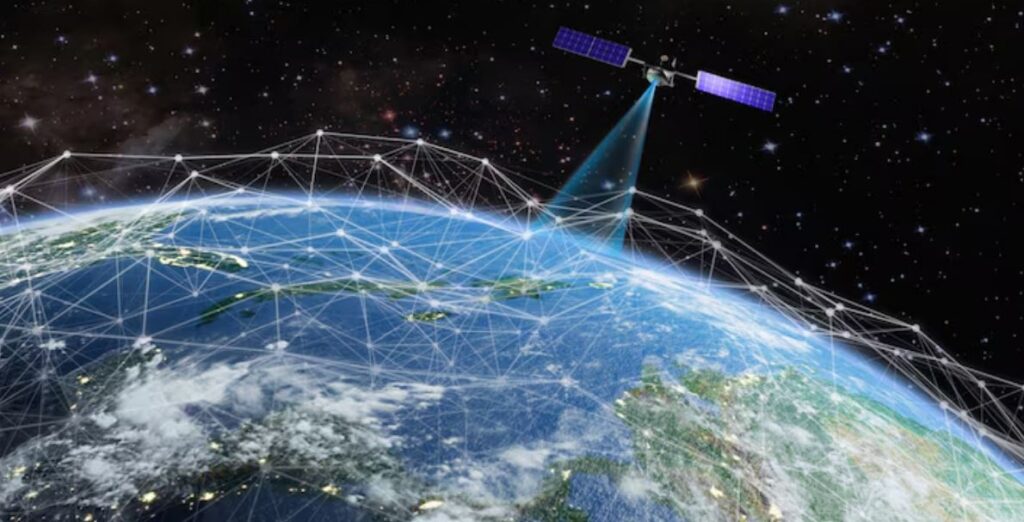
A strange thing can now occur on a peaceful hillside far from any city lights. Suddenly, a phone without bars—the kind where calls fail instantly and maps won’t load—manages to send a text message. The message ends up in an unexpected place. Not to a nearby cell tower. Not via underground fiber wires.
Instead, it goes upward. Straight into space. Direct-to-cellular satellite technology is still new enough that even engineers sometimes describe it with a kind of cautious excitement. The basic idea is surprisingly simple: satellites acting as temporary cell towers, floating hundreds of kilometers above Earth, catching signals from ordinary smartphones.
| Key Information | Details |
|---|---|
| Technology | Direct-to-Cellular Satellite Communication |
| Typical Orbit | Low Earth Orbit (LEO) ~500–600 km above Earth |
| Main Purpose | Connect standard smartphones to satellites when no cellular towers are available |
| Current Capability | Mostly SMS and emergency messaging |
| Key Companies | SpaceX Starlink, AST SpaceMobile, Globalstar |
| Supporting Networks | Mobile carriers like T-Mobile, Verizon, AT&T |
| Satellite Type | LEO communication satellites with phased-array antennas |
| Requirement | Clear view of the sky and supported phone model |
| Typical Data Path | Phone → Satellite → Ground Station → Telecom Network |
| Reference | https://regionaltechhub.org.au/satellite-to-mobile-stm |
However, the route your message takes after you hit “send” is more intricate than most people realize.
Typically, a text message passes through adjacent infrastructure. After connecting to a cell tower, your phone transmits data to the recipient’s device via telecom networks. The process is based on decades of infrastructure, including switching centers, fiber cables, and antennas.
However, that infrastructure just doesn’t exist in remote areas. During a satellite connectivity test last year, engineers reportedly observed phones struggling to find a signal for several minutes while standing on a rocky ridge in rural Montana. Then one device finally locked onto a satellite overhead.
The message was sent. It’s difficult to ignore how peculiar the communication path is as you watch this develop. In order to communicate with a typical cell tower, the phone first sends out a radio signal. The phone itself is not particularly magical. The difference lies in what’s listening above.
Low Earth Orbit satellites — often around 500 kilometers above the surface — carry specialized antennas designed to detect extremely weak signals from smartphones. These antennas, which concentrate radio waves into narrow beams, are surprisingly strong.
The satellite actually acts like a very tall tower. An impossibly tall one. There’s a feeling that the physics by itself seems unlikely. After all, your phone is only a few kilometers from the majority of cellular towers. In contrast, a satellite could be 300 miles above you.
However, a radio signal is not always destroyed by distance. It just makes it weaker. Satellites compensate using high-gain antennas and sophisticated signal processing. These antennas gather minuscule radio energy fragments, such as the faint murmurs of your phone’s transmission, and transform them into data that can be used.
Once the satellite receives the signal, the real routing process begins. The satellite typically relays the message downward to a ground station somewhere on Earth. The same international networks that manage billions of phone calls and texts every day are directly connected to these ground stations.
From there, your message travels through normal carrier systems until it reaches the recipient’s phone.
To put it another way, only the first part of the trip takes place in space. Many users might envision their message hopping straight from one satellite to another before it reaches the intended recipient. That may eventually occur in some networks, especially when satellites use laser links to communicate.
However, the majority of early direct-to-cell systems depend on ground stations to finish the connection.
Additionally, the majority of services currently only accept text messages for a reason. A simple SMS message contains only a tiny amount of data. Much more capacity is needed for a video stream or voice call. Satellites serving thousands of phones simultaneously must divide limited radio spectrum among all those devices.
Text messages are small enough to squeeze through. Engineers working on the technology often compare the system to early dial-up internet. It functions. But slowly. Carefully. Designed for reliability rather than speed.
Over time, that restriction might alter. Businesses like Globalstar, AST SpaceMobile, and SpaceX are competing to launch satellites with stronger radios and bigger antennas. Some of the newest spacecraft unfold massive arrays once in orbit — structures roughly the size of tennis courts.
Capturing more signal from more phones is the straightforward objective. Still, the technology comes with quirks. Direct-to-cell connections usually require a clear view of the sky. The signal may be obstructed by buildings, mountain ridges, or dense forests. It can occasionally be somewhat weakened even by cloud cover.
Low Earth Orbit satellites travel swiftly across the sky, completing an orbit approximately every ninety minutes. This implies that a phone’s connection window to a specific satellite might only last a few minutes before another spacecraft takes over.
Watching the industry develop, there’s a feeling that mobile networks are quietly expanding beyond the planet’s surface. Companies creating constellations of orbiting hardware are now collaborating with carriers that previously concentrated solely on ground towers.
It’s a strange partnership — telecom companies collaborating with rocket launches. However, the appeal is clear.
Roughly half the Earth’s land area still lacks reliable cellular coverage. mountain ranges, deserts, seas, and isolated villages. locations where it is just not feasible to build towers. Satellites don’t care about terrain because they are above everything.
It’s unclear if full mobile internet will eventually be supported by direct-to-cellular satellites. Engineers appear self-assured. Regulators continue to exercise caution. Investors seem upbeat.
