

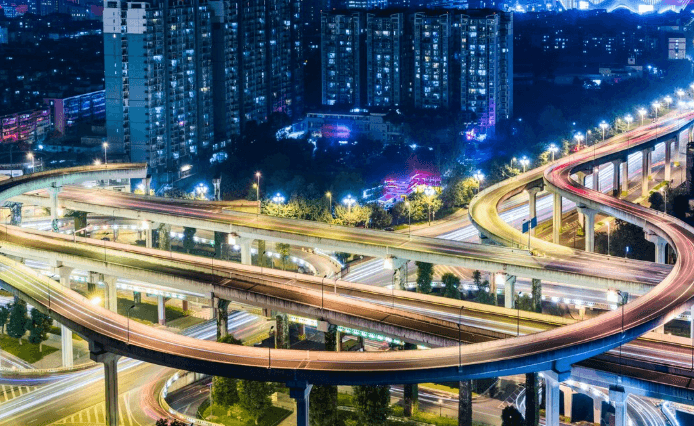
Just before dusk, something subtle occurs at a busy intersection in Singapore. Cars don’t follow the typical stop-and-go pattern; instead, they slow down and then accelerate. There is no sense of rigidity in the traffic light. As a wave of cars approaches, it changes—almost instinctively—stretching green for a few more seconds before tightening once more as the road clears. Nobody is aware of it. Perhaps that’s the point.
Like the weather, traffic jams have always seemed inevitable. You anticipate them. You gripe about them. Your life is organized around them. However, this assumption is being subtly challenged in an increasing number of cities—not with larger or new roads, but with something less obvious. algorithms, monitoring, forecasting, and real-time adjustment.
| Category | Details |
|---|---|
| Technology | AI-powered traffic management systems |
| Core Tools | Sensors, cameras, GPS data, machine learning |
| Key Function | Real-time traffic prediction and signal optimization |
| Major Use Cases | Smart traffic lights, route optimization, public transport control |
| Global Examples | Singapore, Los Angeles, Pittsburgh, San Diego |
| Measurable Impact | Up to 20% reduction in travel time (estimates) |
| Environmental Benefit | Lower emissions from reduced idling |
| Key Challenge | Data integration and infrastructure costs |
| Future Potential | Integration with autonomous vehicles |
| Reference | https://www.bbc.com/future/article/20181212-can-artificial-intelligence-end-traffic-jams |
Traffic systems followed set schedules for many years. Intersections ran on routines that seemed strangely detached from reality, and lights changed whether or not cars were there. The frustration is familiar to anyone who has sat at an empty red light late at night. It felt out of date in addition to being ineffective.
AI modifies that equation in a way that is both straightforward and unexpectedly intricate. Roadside sensors, pole-mounted cameras, and GPS signals from thousands of phones all provide data to systems that recognize patterns, predict traffic, and respond nearly instantly. It’s possible that traffic, which used to be unpredictable and chaotic, is now more controlled and even choreographed.
Early implementations have already resulted in a slight but noticeable reduction in travel times in cities such as Los Angeles. It sounds incremental. However, even a small improvement feels big when you’re at a busy intersection during rush hour. fewer sudden stops. shorter wait times. a quieter, more fluid flow.
Transportation engineers frequently cite a particular moment in Pittsburgh. Wait times at intersections were cut by almost a third thanks to an AI-driven system that started dynamically modifying signals. Observing it in action gives the impression that the city is thinking, reacting not only to automobiles but also to patterns that are developing moment by moment.
However, the notion of completely “eradicating” traffic jams seems ambitious, if not optimistic. Cities are disorganized. Human nature is erratic. Accidents do occur. Everything is altered by the weather. Whether AI can completely remove congestion or just make it easier to handle is still up for debate.
The way these systems manage complexity is more compelling. They attempt to prevent issues rather than responding to them after they arise. By examining both past patterns and current data, predictive models are able to identify early indicators of a bottleneck, such as decreasing speeds or increasing density, and take action before the jam gets out of control. This proactive approach seems like a mental change. Preventing traffic rather than fixing it.
Public transport is also part of this transformation, though it receives less attention. Trains synchronize schedules dynamically, buses modify routes in response to demand, and systems redistribute capacity where it is most needed. Theoretically, this eases traffic on the roads and encourages people to use more economical forms of transportation. In actuality, the outcomes are inconsistent, improving in certain cities while falling behind in others.
One scene depicts a rainy evening commute in London, with buses arriving slightly more evenly than before and crowds dispersing faster. It’s not overly dramatic. But if you’re paying attention, you can see it.
An additional layer is added by the environmental angle. In addition to being inconvenient, traffic congestion has a negative financial and environmental impact. Idling engines waste time, emit emissions, and burn fuel. AI systems discreetly cut that waste by streamlining traffic. Although it’s not a comprehensive solution to climate issues, it’s a step that seems realistic and almost instantaneous. Beneath the surface, however, is a trade-off.
Data is essential to these systems. Much of it. Devices continuously transmit location data, cameras monitor movement, and sensors capture patterns. It seems that as cities grow smarter, they also become more perceptive, observing not only traffic but also the people living there. It’s an unresolved balance.
As this develops, there’s a sense that one of the first common issues to be significantly altered by AI could be traffic. It was gradually softened and made less disruptive rather than completely replaced or eradicated overnight. Hesitancy persists.
Not everything can be controlled by even the most sophisticated systems. A flash of rain. A car that has stopped. A street-wide celebration. The use of algorithms does not eliminate the unpredictability of urban life. It adjusts, occasionally defying optimization in surprising ways.
However, it’s difficult not to believe that something has changed when you stand at that intersection in Singapore and watch cars pass through what was once a bottleneck with near ease. Not in a big way. Not very loudly. But enough to be noticeable.
And perhaps that’s how traffic bottlenecks start to go away—not with a big fix, but with a lot of little changes made discreetly, one intersection at a time.
