

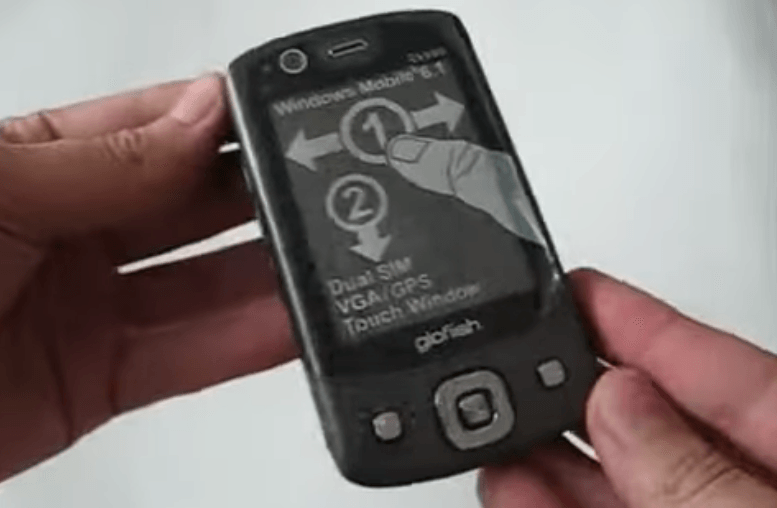
Credit: Smartmania.cz
For a short while in 2008, the smartphone market still felt more like a workshop than a completed showroom. Businesses were experimenting, occasionally in a brilliant way and other times in an awkward way. The E-TEN Glofiish DX900, a phone that attempted to do something surprisingly useful—run two SIM cards simultaneously—appeared somewhere in that disorganized workbench of ideas.
Now, that notion seems commonplace. Dual-SIM phones are commonplace in today’s phone markets. However, the idea was practically unheard of at the time, particularly on a smartphone running Windows Mobile. The DX900 was more than just a curious technical device. It was the first Windows Mobile dual-SIM phone with EDGE and HSDPA capabilities, and when it made its debut at Computex 2008 in Taipei, engineers and gadget journalists took notice.
| Category | Details |
|---|---|
| Device | E-TEN Glofiish DX900 |
| Manufacturer | E-TEN Information Systems |
| Announcement | June 2008 |
| Release | December 2008 |
| Operating System | Microsoft Windows Mobile 6.1 Professional |
| Processor | Samsung S3C6400 – 533 MHz |
| RAM / Storage | 128 MB RAM / 256 MB ROM |
| Display | 2.8-inch VGA touchscreen (480×640) |
| Camera | 3.15 MP autofocus |
| Key Feature | First Windows Mobile dual-SIM smartphone |
| Connectivity | HSDPA, GSM, Wi-Fi, Bluetooth, GPS |
| Reference | https://www.gsmarena.com/eten_glofiish_dx900-2545.php |
The device itself had a thick, rectangular, somewhat industrial appearance, similar to many Windows Mobile phones of its time. The front was dominated by a 2.8-inch VGA touchscreen with tiny hardware buttons that seemed more functional than aesthetically pleasing. The plastic case, which I’m holding right now, has that subtle rubberized feel that characterizes smartphones from the late 2000s. Realistic. A little somber. It was the type of gadget that appeared more at ease in a business setting than in a coffee shop.
The hardware that E-TEN included in the phone seemed ambitious for its time. In comparison to many Windows Mobile devices, the DX900’s 533 MHz Samsung processor and 128 MB of RAM were regarded as generous. Apps opened fairly quickly. Not immediately—nothing in Windows Mobile ever felt that way—but fast enough to imply that the device had genuine power hidden beneath its humble exterior.
Attention should also be paid to the screen. Sharp text and dense icons were produced by a 2.8-inch panel with a VGA resolution display (480 × 640). Suddenly, compared to many competing phones, it felt less crowded to read emails or browse spreadsheets. It’s difficult to avoid picturing a business traveler in an airport lounge in 2008, using a stylus to browse through Outlook messages as they await boarding.
Naturally, though, the key trick was located underneath the battery cover. two SIM card slots.
That feature was very valuable to users in Russia, Eastern Europe, and parts of Asia, where E-TEN was well-established in the market. Use one number for business calls and another for personal ones. Or maybe one SIM for cheaper international roaming and another for domestic service. It must have felt subtly revolutionary to watch the phone switch between two networks at once.
E-TEN seemed to have a thorough understanding of those markets. For instance, it was reported that in early 2008, the company owned over 20 percent of Windows Mobile devices in Russia. Considering that HTC controlled the majority of the global Windows Mobile market, that is an impressive number.
However, the DX900 was more than just SIM cards. The phone had a long list of features that engineers enjoyed creating back then. Wi-Fi, Bluetooth, microSD expansion, GPS with the SiRF Star III chipset, and even TV-out capability for content display on external screens. The 3.15-megapixel autofocus camera produced decent images for the period, sharp enough for MMS sharing or fast prints.
But when you use the phone today, another thing becomes evident. More than a contemporary smartphone, the gadget has the feel of a tiny computer. The menus on Windows Mobile expand into more detailed menus. The settings are hidden behind tab layers. The stylus stops being optional and becomes necessary. Yes, it’s a powerful piece of software, but it’s also incredibly complex.
Expectations were being altered by Apple’s iPhone at the same time that the DX900 was released. Touch screens were getting more fluid. Android was getting ready to go live. Simplicity was starting to take precedence over feature density in phones. It’s possible that the DX900 already felt a little out of step with the direction the market was taking as that change took place.
However, the gadget continued to exude ambition. It even garnered praise at Computex 2008, where the DX900 was named the Best Choice Award winner. Visitors reportedly paused to inspect the phone as they passed the E-TEN booth at the event, intrigued by the hardware’s unexpected durability and dual-SIM implementation.
E-TEN’s engineering team and smartphone technology were acquired by Acer earlier in 2008 for about $290 million. Acer branding eventually took the place of the E-TEN name. In a way, the DX900 itself survived—it was subsequently marketed under the Acer brand—but the original brand identity gradually vanished.
It’s difficult to ignore the timing. During a year of transition in mobile technology, the DX900 made its debut. Ecosystems were developing, smartphones were changing rapidly, and smaller manufacturers were finding it difficult to compete with larger firms’ marketing might.
In retrospect, the DX900 seems like a snapshot of that uncertain time. Arriving at the same time that the industry started to simplify everything, this device was full of ideas, some of which were experimental and some of which were practical.
There is a sense that the phone might have attracted more users if it had debuted two or three years later, running Android and featuring a more seamless interface. Or maybe the same intense competition would have swept it away anyhow.
In any case, the E-TEN Glofiish DX900 is still a fascinating relic from the early days of smartphone design, when we were still figuring out what we should put in our pockets. And occasionally, when holding one, it’s difficult to avoid wondering if the industry progressed or just took a different turn.
