

Credit: Men’s awareness
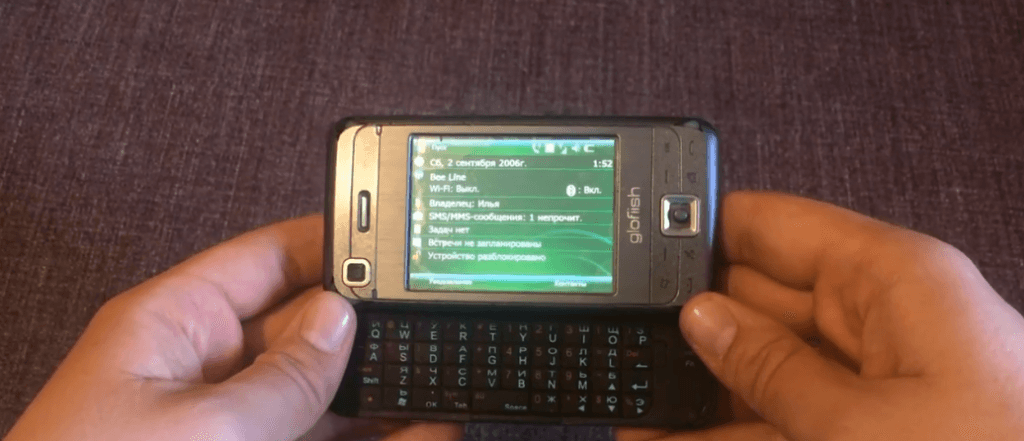
Smartphones used to resemble tiny mechanical experiments rather than sleek glass slabs in the late 2000s. The hinges opened with a click. The screens moved up. Keyboards emerged from concealed spaces. The Glofiish M800, a gadget that felt committed to demonstrating that a smartphone could also function as a tiny laptop, was a product of that era.
The first thing that strikes you when you pick up the M800 is how heavy it is. It doesn’t feel delicate or fragile at 178 grams. It seems intentional. It’s almost serious. The density of the phone indicates that engineers continued to cram parts inside until the casing could no longer accommodate them.
| Category | Details |
|---|---|
| Device | E-TEN Glofiish M800 |
| Manufacturer | E-TEN Information Systems |
| Announcement | October 2007 |
| Release | March 2008 |
| Operating System | Microsoft Windows Mobile 6.0 |
| Processor | Samsung S3C2442 – 500 MHz |
| RAM / Storage | 64 MB RAM / 256 MB ROM |
| Display | 2.8-inch VGA touchscreen (640 × 480) |
| Keyboard | Slide-out QWERTY |
| Connectivity | HSDPA (3.5G), Wi-Fi, Bluetooth |
| Special Features | GPS (SiRF Star III), FM radio |
| Reference | https://www.gsmarena.com/eten_glofiish_m800-2163.php |
With a tiny mechanical snap, the keyboard becomes visible when you slide the screen upward. Each key is slightly raised, and the QWERTY layout glows dimly in backlight. Even now, it’s the kind of tactile experience that is strangely fulfilling. Instead of being a quick tap on the glass, typing a message becomes a physical act.
That keyboard was important back in 2008, when the device first came out. Smartphones were still figuring out how users wanted to compose emails while they were on the go. Some gadgets required input via a stylus. Others made use of small hardware keys. The M800 followed the second route, providing a full keyboard for work emails and longer messages.
Microsoft’s attempt to incorporate desktop computing logic into a portable device, Windows Mobile 6.0, was installed on the phone. Anyone who has ever used Windows on a PC will recognize the interface when it opens. Menus, folders, task lists, and Word and Excel versions are all waiting to be opened.
It’s probable that the design was intended to appeal to professionals who use smartphones after work and laptops during the day. Those two worlds were attempted to be combined by the M800.
That goal was significantly influenced by the screen. At a time when many phones still used lower-resolution QVGA screens, the device’s 2.8-inch VGA display with 640 × 480 resolution was a sharp panel. The text looked clear. Emails appeared readable and dense. In fact, spreadsheets could show more than one column without becoming unreadable.
Nevertheless, there was a minor trade-off with the display. Like many resistive touchscreens of the era, the screen had some difficulty in direct sunlight. On a bright afternoon outside, the brightness may seem a bit muted, requiring users to tilt their phones to get a better view.
However, the display looked great indoors.
A Samsung processor running at 500 MHz and 64 MB of RAM were installed under the hood by E-TEN. Performance for a Windows Mobile device was respectable thanks to that combination. Although they didn’t open right away, applications progressed gradually. One of those little reminders that smartphones were still learning how to be fast was that opening an email client or loading a GPS program frequently required a quick pause.
The phone was compatible with HSDPA, which was then commonly known as 3.5G. When compared to older EDGE networks, this meant notably faster mobile data speeds. The difference may seem significant to someone loading early mobile web pages or downloading email attachments.
The gadget was remarkably versatile for its time thanks to the addition of Bluetooth and Wi-Fi. Next came GPS.
The SiRF Star III GPS chipset, which was used in the M800 and many other Glofiish devices, had established a solid reputation for accuracy and dependability. The phone could lock onto satellites and show location data with remarkable accuracy while standing on a busy street with navigation software open.
It’s difficult not to picture a traveler in 2008 exiting a train station in Europe, pulling out the M800, and watching as traffic hums in the background while a digital map slowly orients itself.
There was a 2-megapixel camera on the phone as well. It seems simple by today’s standards, but it was functional at the time. Photos were allowed for brief snapshots and MMS messages. The camera was just another tool in a device that already had a lot of them; it wasn’t the main attraction.
It’s evident from looking at the M800 now that E-TEN wanted to compete with businesses like HTC, which ruled the Windows Mobile market. The hardware had big plans. The list of features was lengthy. Personality was added by the sliding keyboard. However, the timing was difficult.
Apple’s iPhone, which prioritized seamless touch interaction over physical keyboards, was revolutionizing smartphone design at the same time. Android, which would introduce a new software philosophy to mobile devices, was getting ready to launch.
The M800 belonged to the generation that preceded the full implementation of that transformation.
There is a certain allure to the device’s resolve to do everything, as seen by the way the keyboard slides open and the menus appear on the screen. It aimed to be a small computer, a music player, a GPS navigator, and a phone. Its challenge, as well as its strength, might have been that ambition.
It’s difficult to ignore how many concepts the phone attempted to fit into its small size. A few were excellent. Others felt a little more complex. However, the endeavor itself is still intriguing.
In the history of smartphones, the Glofiish M800 is remembered as one of those gadgets that caught a turning point, when engineers were still figuring out how a pocket computer should work and nobody was completely certain which way the future would go.
