

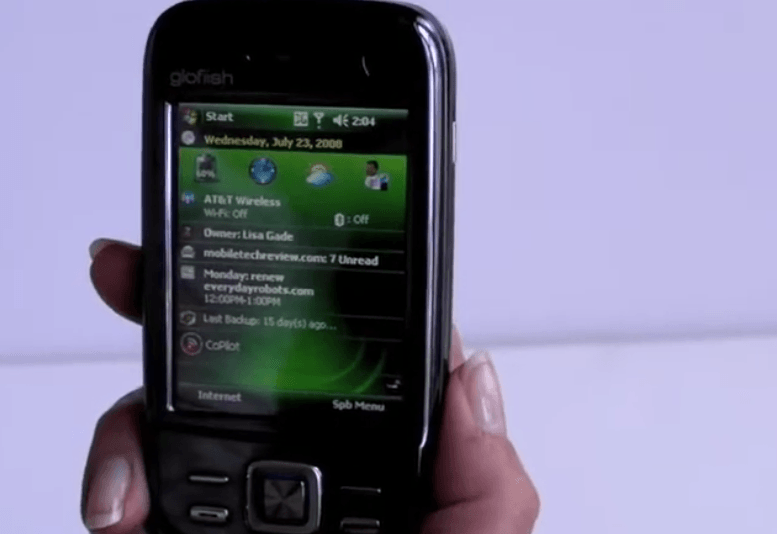
Credit: Mobile TechReview
The Glofiish M810 debuted at an odd point in the history of smartphones. The industry was still debating what a smartphone should look like in 2008. Some businesses thought sliding keyboards were the way of the future. Others thought it would be solely based on touch. In public, engineers were conducting experiments. The M810 seemed to be a component of those experiments.
The gadget appeared solemn at first glance, almost defiantly professional. The front panel had a subtle, slightly industrial dark graphite finish. It appeared more like a small office tool than a consumer device when it was placed on a desk next to a laptop.
| Category | Details |
|---|---|
| Device | E-TEN Glofiish M810 |
| Manufacturer | E-TEN Information Systems |
| Announcement | April 2008 |
| Release | August 2008 |
| Operating System | Microsoft Windows Mobile 6.0 Professional |
| Processor | Samsung S3C2442 – 500 MHz |
| RAM / Storage | 64 MB RAM / 256 MB ROM |
| Display | 2.8-inch TFT touchscreen (320 × 240) |
| Keyboard | Slide-out QWERTY |
| Connectivity | HSDPA, Wi-Fi, Bluetooth |
| Extra Features | GPS (SiRF Star III), FM radio |
| Reference | https://www.gsmarena.com/eten_glofiish_m810-2343.php |
The weight becomes apparent when you pick it up. The phone feels heavy in the hand, weighing close to 179 grams and measuring 17.5 millimeters in thickness. It could be considered bulky. Some may find it comforting. In any case, it’s not a gadget that slips into a pocket.
A full QWERTY keyboard is hidden beneath the mechanism, which opens with a gentle clack when the screen is slid upward. It’s still strangely satisfying to watch that motion. The phone abruptly changes into something that resembles a tiny computer as the display rises and the keyboard appears.
That keyboard had actual meaning back in 2008.
The use of smartphones for documents, email, and instant messaging has grown. A lot of professionals wanted to type fast without using virtual keyboards or stylus input. Devices such as the M810 attempted to use hardware keys to address that issue.
Although they might not be flawless, the keys themselves are functional. The letters are positioned on a flat plastic surface with raised edges. Typing is functional, but it’s not quite the same as typing on a laptop keyboard, which provides crisp feedback. Nevertheless, it was a useful tool for lengthy emails while traveling by train or in a taxi.
Windows Mobile 6.0 Professional, Microsoft’s bold attempt to fit a desktop experience into a pocket, powers the gadget. When the interface is opened, users who have used Windows XP will notice that the menus, folders, and applications appear remarkably familiar.
It is possible to open Word documents. It is possible to view Excel sheets. Email and corporate servers are synchronized.
The gadget might have been made for business travelers who needed to move between conference rooms and airports. The type of people who browse spreadsheets during lengthy taxi rides across foreign cities or check messages while waiting at departure gates.
The screen has a resolution of 320 × 240 pixels and is 2.8 inches in size. The resolution seems low in comparison to the sharper VGA screens found on some competitors. However, the navigation is still sufficiently clear for everyday use, and the text is still readable.
The resistive touchscreen occasionally falters a little outside in bright light, requiring users to change their viewing angles. That was typical for the time. It was still a few years before smartphones would be dominated by glass screens.
The phone’s internal components include a Samsung processor running at 500 MHz and 64 MB of RAM. In 2008, that appeared respectable on paper. Performance may seem erratic in practice.
Sometimes it took patience to open applications. Occasionally, screen transitions seemed slow, particularly when navigating from portrait to landscape mode after opening the keyboard. At the time, it was just a part of the experience, but contemporary smartphones have largely eliminated this kind of delay. In terms of connectivity, the M810 really demonstrated ambition.
With HSDPA support, the phone’s mobile data speeds were noticeably faster than those of previous networks. As a result, emails, attachments, and web pages loaded faster than many users had previously experienced on a phone.
The device’s inclusion of Wi-Fi and Bluetooth made it adaptable to use in homes, workplaces, and cafés.
The GPS receiver, which was powered by the renowned SiRF Star III chipset, came next. At the time, it seemed subtly futuristic to watch the phone lock onto satellites for navigation. There was a sense of technological magic to standing on a busy street corner while a map slowly appeared on the screen. It’s simple to forget how thrilling mobile GPS used to be.
In addition, the phone had a tiny front camera for video calls and a 2-megapixel autofocus camera. Even though there was little detail, the pictures were good for informal photos and displayed natural colors.
It wasn’t an attempt to take the place of a digital camera. In an already overcrowded list of features, it was just one more capability.
When considering the industry as a whole, the M810 entered a highly competitive setting. Similar sliding keyboards were used in Windows Mobile devices made by companies like HTC, who frequently improved the idea a little bit.
Apple’s iPhone was subtly changing expectations at the same time. In contrast, the slick touch gestures and seamless browsing made the older interfaces feel awkward. Additionally, Android smartphones were starting to show up, bringing with them new software concepts. In the midst of that change was the M810.
Using the well-known Windows Mobile framework, it attempted to integrate new mobile features like multimedia, fast data, and GPS with conventional smartphone hardware.
As you watch the device today, navigating through menus and sliding open its keyboard, you get the impression that engineers are pushing in multiple directions at once. They desired productivity, power, and connectivity. A little amusement, perhaps. There was still disagreement over whether the formula actually worked.
A fascinating period in mobile technology, however, is captured by the Glofiish M810—a time when the industry was still experimenting with form and trying to find the ideal balance between a phone and a pocket computer. For a short while, gadgets such as these carried the unspoken conviction that both worlds could coexist peacefully in a single sliding frame.
