

You’ll notice something that wasn’t there ten years ago if you walk into any serious research lab today. It’s not exactly a brand-new instrument. Behind the server rack, there isn’t a louder fan or a new desk. It’s how scientists communicate with their screens.
They quarrel with them. They inquire further. They wait for responses in the same manner that someone waits for a coworker who has gone to get coffee. As this develops, it seems as though the scientist-software relationship has subtly changed to one that is more conversational and even collaborative.
| Field | Detail |
|---|---|
| Strategy Name | A European Strategy for Artificial Intelligence in Science |
| Initiative | Resource for AI Science in Europe (RAISE) |
| Lead Body | Joint Research Centre (JRC), European Commission |
| Year Announced | 2025 |
| EU Share of Global AI Research Players | 13% (US 4%, China 1%) |
| Key Application Areas | Protein structure prediction, material discovery, drug development, climate modelling, computational humanities |
| Notable Breakthrough Cited | DeepMind’s AlphaFold |
| Future Oversight Body | AI Evaluation Hub (led by JRC) |
| Core Concerns | Hallucinations, biased data, energy demand, reproducibility |
| Supporting Frameworks | EU Competitiveness Compass (Jan 2025), Clean Industrial Deal (Feb 2025) |
The figures supporting that change are beginning to seem plausible. Approximately two out of every five global AI players had at least one research or innovation activity connected to them up until 2024, according to the European Commission’s Joint Research Center, and the EU currently has the biggest share of that market. Thirteen percent, compared to one percent for China and four for the United States. Some analysts were taken aback by this figure, which is the kind of statistic that subtly changes the way funding decisions are made in Berlin and Brussels.
This is intended to be furthered by the new European strategy known as RAISE. A future AI Evaluation Hub, open data, and shared infrastructure are all promised. It appears to be policy on paper. In actuality, it’s an acknowledgement that the traditional method of conducting science—one researcher, one hypothesis, one arduous decade—can no longer keep up. Policymakers seem to be in a hurry to avoid becoming a client of foreign intelligence, as evidenced by the language used in the documents.
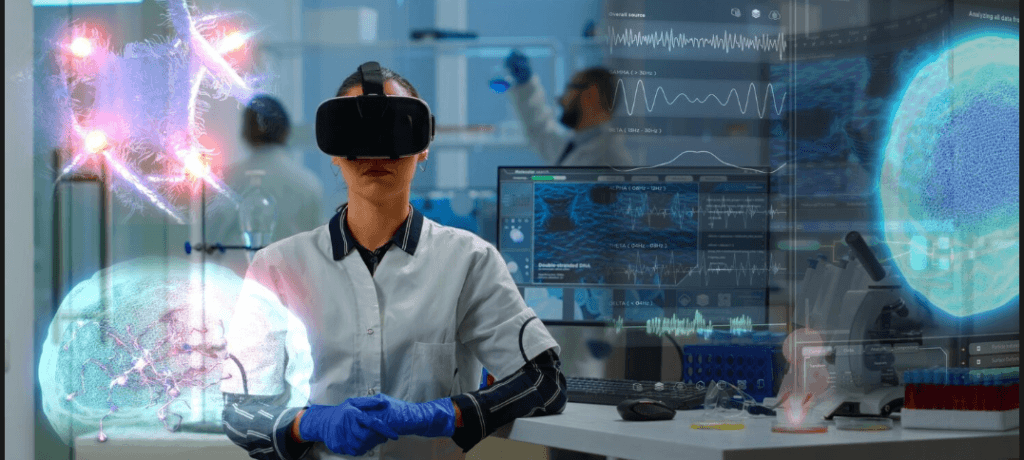
It is more difficult to describe what AI is truly doing in labs than any white paper would indicate. Protein structure was revealed by AlphaFold in a way that left structural biologists feeling both ecstatic and jobless. It used to take quarters for drug discovery teams to sketch out potential molecules in the afternoons. Climate modelers use disorganized decades’ worth of weather data to extract patterns that are impossible for the human eye to recognize. It’s difficult to ignore the fact that every new discovery is met with less surprise than the previous one. We’re growing accustomed to miracles, which is a problem in and of itself.
However, the cracks are visible beneath the headlines. Sometimes, conclusions drawn by large language models that have been trained to mine millions of papers are not entirely accurate. Models have hallucinations; they create outcomes that appear sophisticated, almost beautiful, but are actually physically impossible. Materials scientists have quietly acknowledged that some AI-generated compounds just don’t exist as the algorithm predicted when tested in a real lab. Whether the field has fully considered this is still up for debate. Most likely not.
Talent is the other silent anxiety. People with hybrid minds—those who are proficient in biology and code, physics and statistics, ethics and engineering—are needed for AI in science. These individuals are uncommon, and as soon as they receive training, they usually vanish into the workforce. Academic institutions are rushing to retain them. A few are doing well. Most aren’t.
As this develops, it’s tempting to refer to AI as science’s most potent instrument. Perhaps it is. However, even strong tools cannot take the place of judgment. Depending on who is holding them, they either sharpen or dull it. Which will be determined by the quiet labs operating in Heidelberg, Cambridge, and Lahore tonight.
