

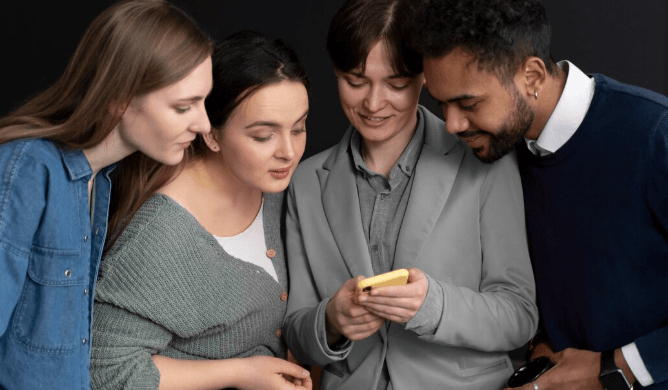
A fruit vendor in a busy Lahore market stops in the middle of a transaction and takes out his phone to verify a payment. No money is exchanged. After a brief glance and a gentle vibration, the transaction is completed. The real transaction takes place inside a screen that is barely six inches wide while motorcycles pass by and vendors shout prices. It’s difficult to ignore how commonplace this has become.
The takeover of the digital economy by smartphones was not announced. There was no clear turning point, no single moment. Rather, they permeated every aspect of life, including payments, transportation, and entertainment, until they evolved from mere gadgets to something more akin to infrastructure. The majority of people might not have even been aware of the change.
| Category | Details |
|---|---|
| Technology Origin | Mobile phones (first call in 1973, Motorola) |
| Modern Device Evolution | Smartphones (2007 onward) |
| Global Reach | Over 5.4 billion mobile users worldwide |
| Economic Impact | Contributes to GDP growth (1.8–2.2% in connected regions) |
| Core Functions | Communication, commerce, banking, entertainment |
| Key Ecosystem | Apps, mobile payments, cloud services |
| Industry Drivers | AI, 5G, app economy, digital services |
| Future Outlook | Smartphones becoming integrated life hubs by 2030 |
| Key Insight | Smartphones evolving into central control systems of digital life |
| Reference | https://nielseniq.com/global/en/insights/ |
That first mobile phone call in 1973 is arguably where the story started decades ago. It must have felt clumsy and experimental at the time. Talking while on the go is a simple problem that this large gadget solves. But as time went on, that limited purpose grew, adding capability after capability, transforming a communication tool into something much more intricate.
Phones were already altering behavior by the early 2000s. People stopped learning numbers by heart. Planning became less rigid. The change quickened with the introduction of smartphones, which put the internet in people’s pockets. As this develops, it seems that behavior rather than technology was the true change.
Almost silently, the app economy began to take shape. Each of the tiny icons on glass screens represents a service that previously needed a physical location or a human middleman. banking. Purchasing. transportation. delivery of food. entire sectors, condensing into interactions based on taps. Investors appeared to pick up on this early on, investing heavily in startups based solely on mobile-first presumptions.
The speed at which the smartphone took over as the primary gateway is remarkable. It was the only digital access point in many regions of the world, particularly in Asia and Africa. People completely abandoned desktop computers in favor of a mobile-first lifestyle. Economies were reshaped by that leapfrogging effect in ways that are still undervalued.
Someone standing on a street corner, using one hand to navigate, using another app to order a ride, and simultaneously messaging a friend is a scene that appears in many cities. Multiple layers of economic activity, compressed into a single moment. It seems effective. It feels a little overwhelming, too.
The figures support this change. Measurable GDP growth has been associated with mobile connectivity, and research indicates that areas that transition from no coverage to full coverage experience discernible economic benefits. That sounds ethereal. On the ground, however, it appears as workers getting paid right away, farmers accessing market prices, and small businesses finding clients.
However, smartphones are now used for more than just transactions. It is evolving into something more akin to a control center. Nowadays, a lot of things revolve around the phone and use it as a central hub, including wearable technology, smart homes, and even automobiles. It seems as though the gadget is no longer merely a component of the ecosystem. The ecosystem is what it is.
Businesses appear to be making the necessary adjustments. Tech companies are now creating environments centered around phones rather than just hardware and software. Predictive interfaces, seamless user experiences, and systems that anticipate future user needs. The extent to which these systems subtly influence consumers’ daily decision-making is still unknown.
Additionally, there is a cultural shift that is more difficult to measure. People’s perceptions of time and attention have been altered by smartphones. Previously a passive experience, waiting is now instantly filled with scrolling, watching, and responding. Every moment of inactivity turns into a chance for interaction and, consequently, economic activity.
Beneath all of this, though, is a subtle tension. Convenience is made possible by the same device that concentrates power. Access is managed by platforms. Visibility is shaped by algorithms. The smartphone economy may be concentrating power in a smaller number of hands while simultaneously creating more opportunities.
Screens glow in the low light as you stroll through a late-night café. Some are working, some are watching videos, and some are just aimlessly scrolling. It’s challenging to distinguish between habit and productivity. The boundary seems hazy.
Perhaps that’s the point.
The digital economy was not overtaken by smartphones. It achieved this by becoming indispensable and becoming so ingrained in daily life that it is now practically unimaginable to remove it. As this develops, one question remains: will these gadgets become even more important in the future, or will something else subtly start to take their place, similar to how smartphones once supplanted everything else?
