

The silence inside a vertical farm is the first thing visitors notice. There is no wind. There is no dirt underfoot. Just rows of lettuce, arranged floor to ceiling like plant shelves in a library, softly glowing under pink LED lights. It’s difficult to avoid feeling a little skeptical when you’re in one of these facilities. Food is growing inside a structure that was formerly used to store auto parts. After all, it was never intended for cities to produce their own food.
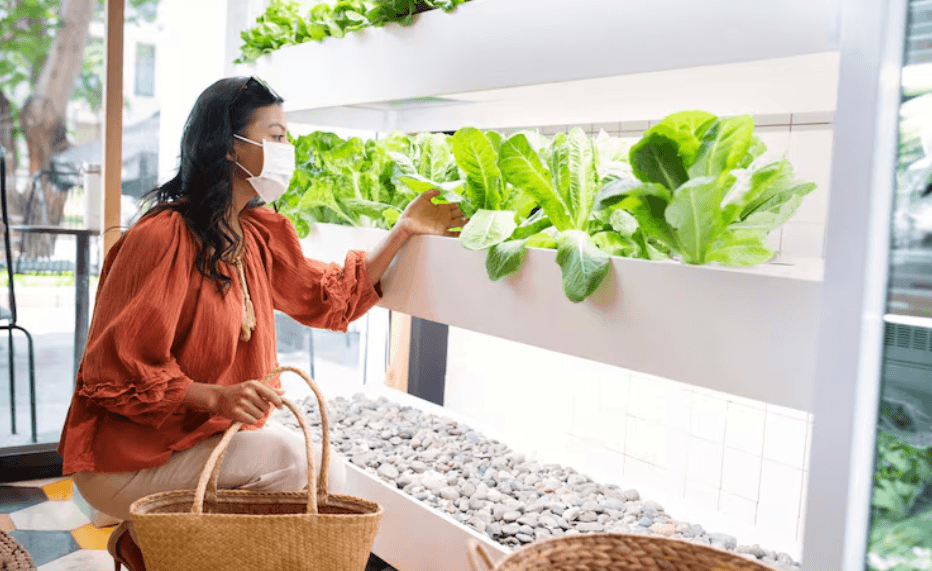
Urban life has relied on far-off farmland for the majority of modern history. trucks transporting California spinach. ships from halfway around the world that are loaded with grain. It functions—until it doesn’t. Chains of supply stall. The weather becomes peculiar. The cost of fuel rises. Grocery shelves appear thinner than normal all of a sudden. There is a growing awareness that cities might require a backup plan after witnessing those moments in recent years. One of the more serious attempts seems to be vertical farming.
| Category | Details |
|---|---|
| Concept | Growing crops in vertically stacked layers inside buildings using controlled environments |
| Primary Method | Hydroponics, where plants grow in nutrient-rich water rather than soil |
| Productivity | Up to 390× more food per square foot compared to traditional farms |
| Water Usage | Up to 90–95% less water than soil-based agriculture |
| Typical Locations | Warehouses, rooftops, shipping containers, basements |
| Major Technologies | AI monitoring, IoT sensors, robotics, LED grow lighting |
| Major Investors | Venture capital firms and agriculture tech startups worldwide |
| Market Trend | By 2025, roughly 65% of urban farms use indoor or hydroponic systems |
| Key Benefit | Shorter food supply chains and year-round production |
| Reference | https://www.fao.org |
The fundamental concept seems almost too straightforward. Farmers grow crops upward rather than across acres of land. With their roots immersed in nutrient-rich water, plants are arranged in stacked trays. No dirt. Not a single tractor. simply controlled settings with sensors keeping an eye on nutrients, light, and temperature.
It’s possible that the precision of the farming technique, rather than the technique itself, is the true breakthrough. Sensors discreetly monitor the water’s electrical conductivity and pH levels. Nutrient flows are adjusted by algorithms. Sometimes planting and harvesting are done by robots. The system resembles a laboratory quietly growing vegetables rather than agriculture. And the figures are startling.
Certain facilities can produce hundreds of times more food per square foot than conventional farms because plants grow in layers rather than fields. Harvests that would typically require acres of land can be produced in a small warehouse. That math is crucial for cities with limited space.
The water savings are equally striking. Crops grown in hydroponic systems typically require about 90% less water than those grown in conventional agriculture because the water is recycled repeatedly. The experiment might be justified on its own in areas where daily life is already impacted by water scarcity. However, proximity might be the true draw to cities.
Before fresh produce reaches urban consumers, it typically travels hundreds or thousands of miles. Before reaching a supermarket refrigerator, spinach may be transported in chilled trucks for several days. The distance between harvest and store can be reduced to a few miles—or occasionally just a few blocks—in vertical farms.
That change has a subtle but significant effect. Food is fresher when it arrives. Trash falls. Emissions from transportation are declining. Suddenly, the supply chain appears shorter and less brittle.
Today, you can occasionally see delivery vans leaving warehouses filled with lettuce that was harvested only hours before as you stroll through some urban farming districts. The distribution of food is altered by this tiny detail. Naturally, pragmatic concerns temper the optimism surrounding vertical farming.
The most obvious one is still energy consumption. Indoor plants require artificial lighting and climate control. The sun is completely replaced by rows of LED lights that run for extended periods of time. Behind the walls, ventilation, heating, and cooling systems are always humming. These systems are expensive. They also bring up awkward environmental issues.
In an effort to reduce the energy burden, some startups are experimenting with solar power or more energy-efficient lighting technologies. It appears that investors are prepared to wait for those advancements. Billions of dollars have poured into indoor agriculture businesses over the last few years, indicating that investors think the economics will eventually work. Scale is another unanswered question.
Vertical farms are ideal for leafy greens. Strawberries, lettuce, and herbs all grow rapidly in controlled conditions. However, it is still challenging to grow staples like corn, rice, and wheat in this manner. For the time being, vertical farming enhances rather than replaces conventional agriculture. Nevertheless, it feels strangely symbolic to see these farms spring up inside urban areas.
Food production facilities are being converted from old warehouses. Automated irrigation systems hum in abandoned industrial buildings. Even abandoned shopping centers and underground bunkers have been turned into indoor farms. Once-forgotten areas are now surprisingly productive. Alongside the technology, something else is quietly taking place.
Local food systems are becoming more robust. Fresh produce is starting to be grown within city limits in areas that were previously thought to be food deserts. Small markets and school visits are held at community farms. Urban agriculture seems to have the potential to reestablish a connection between cities and food production.
It’s unclear if vertical farming will actually alleviate urban food scarcity. Seldom does agriculture provide easy solutions. However, it’s hard not to feel that cities are experimenting with something significant when you stand inside one of these glowing indoor farms and observe rows of greens stretching upward rather than outward.
not a substitute for fields. Not just yet. However, it’s possible that a new agricultural layer is subtly emerging alongside them.
