

In prosthetics research, there’s a moment that sticks in your memory. It’s not the press release or the engineering breakthrough, but rather the more subdued scene where a patient sits across from a doctor, inquiring about the cost and observing how the conversation changes. This field has been characterized for decades by the gap between what is technically feasible and what is financially feasible. But something is beginning to shift.
The bionic limb market has functioned in an odd contradiction for the majority of its recent history. Neural interfaces, AI-assisted mobility, and sensory feedback were examples of technological advancements, but the people who most needed them were lagging behind. A bionic hand from Mobius Bionics, for example, can cost up to $200,000. From a company like Coapt Engineering, even a more basic upper-limb prosthetic with pattern-recognition controls can cost up to $45,000. Luxury goods don’t cost that much. They are costs associated with being able to hold a child’s hand.
About 20% of prosthesis users paid out-of-pocket expenses, according to research published in 2024, and a significant portion of respondents cited affordability as a reason for never using or eventually giving up on a device. The financial risk was significant, particularly for non-veterans. The Department of Veterans Affairs provided much better coverage for veterans, but it was rarely easy for civilians to navigate the complex world of private insurance. Even now, it frequently doesn’t.
This particular moment is unique because multiple threads are simultaneously pulling in the same direction. The cost of manufacturing is decreasing. AI components that previously needed pricey proprietary hardware are becoming more widely available. Additionally, some startups are not treating affordability as a secondary concern, but are explicitly designing for it from the start. Alt-Bionics, a Texas-based company, has estimated that its Genesis hand, which is presently undergoing clinical trials, may retail for about $5,000. That’s still a substantial amount, but it’s not the same as $45,000 or $200,000.
RISE Bionics, an MIT spinout, has reportedly adopted a similar strategy, pricing some of its products 30 to 50 percent less than those of similar rivals. According to some accounts, scenes at partner hospitals appear slightly different as a result; patients who were previously unable to consider advanced prosthetics now have options. It’s still unclear if that will result in long-term adoption. At the point of sale, affordability is just one factor. The ongoing expenses, such as replacement parts, physical therapy, and refittings, can be just as painful as the initial cost.
Jacob George, the director of the NeuroRobotics Lab at the University of Utah, is developing a device that can directly read neural signals, enabling users to operate a prosthetic arm with just their thoughts. Additionally, a partial sense of touch is restored by the technology. It’s one of the more noteworthy advancements in this field, and the FDA has designated it as a Breakthrough Device, indicating that authorities believe it has real potential.
George is cautious in his explanation of the AI element. He has stated that even though it might not be flawless, the wearer is still in charge. That framing is important. Advanced prosthetics are frequently criticized for having such a steep learning curve that many users eventually give them up. An uncooperative arm is not an improvement.
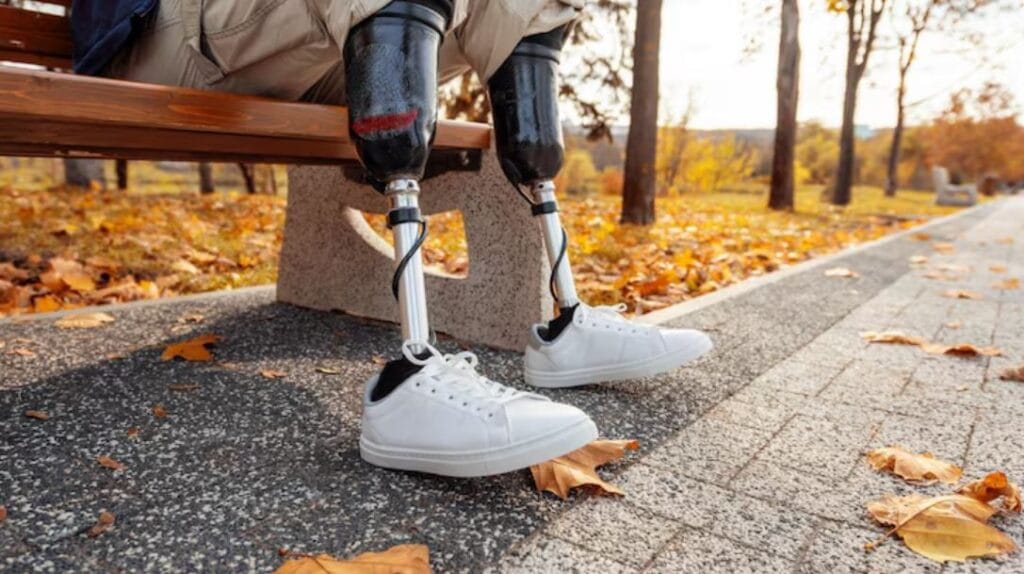
There is a real and underreported issue with abandonment. Technology coverage frequently concentrates on what a device can accomplish in a lab setting with a motivated participant. Less attention is often paid to the realities of everyday use, such as heat buildup, battery depletion, muscle fatigue, and the mental strain of continual recalibration. Corporate affairs executive Sarah de Lagarde, who lost two limbs in a 2022 London Underground accident, has openly discussed the gap between the perception and reality of bionic technology. The battery didn’t last long enough, and her first arm overheated. The cumulative cost of ongoing fittings, physiotherapy, and six-monthly replacements is both financial and psychological.
The market for artificial limbs as a whole is expected to grow to approximately $4.5 billion by the early 2030s, driven in part by real advancements in device capabilities and in part by rising amputation rates associated with diabetes and vascular disease. Prices typically decline when more players enter a market. Despite the fact that medical device markets are infamously resistant to straightforward supply-and-demand reasoning, this dynamic might be at work. Clinical adoption cycles, insurance coverage, and regulatory deadlines all cause delays that are not present in consumer technology.
According to a study referenced by Open Bionics, users produced about nine times the value for every dollar spent on bionic limb technology through enhanced function and employment outcomes. This type of economic framing, which reframes the expense as an investment rather than a liability, tends to influence insurance companies and policy discussions. It’s still unclear if that argument spreads widely or stays limited to research papers.
At this point, it seems more difficult to overlook the fact that the field is at least posing different questions than it did ten years ago. Slowly but imperfectly, the focus has shifted from what is technically possible to what can be delivered to the people who truly need it. That is not insignificant. It could even be the start of something.
