

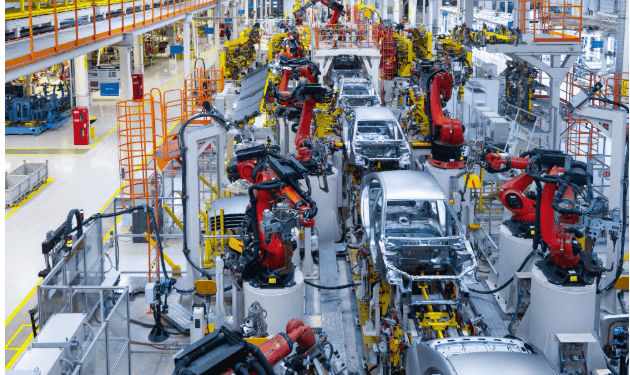
The first thing you notice about Plant Spartanburg, one of BMW’s most productive facilities worldwide, is the floor noise. Conveyor movement, metal presses, and the subdued hum of assembly all operate in unison. With thousands of workers, moving parts, and actual cars being built in real time, it is an operating factory in every sense of the word. Humanoid robots are now performing part of that tasks as well, discreetly incorporated into the same floor area.
BMW’s Physical AI program is neither a press release pilot hidden in a research lab nor a concept announcement. Robots that have spent significant time carrying out real production duties on real automobiles are part of a live deployment that is taking place across two continents. Over 30,000 BMW X3 vehicles were assembled during the 10 months that the Figure 02 robot worked in Spartanburg’s body department, installing sheet metal components prior to welding procedures. It’s not a trial number. It’s a production number.
In 2026, Figure 03 was upgraded and relocated to Hall 52 for a far more complicated task: selecting unsorted parts straight from bins and carefully arranging them into sequencing trolleys. When you see an industrial robot attempt bin-picking, it seems easy. Shapes differ, objects are not aligned, and the task calls for a degree of spatial judgment that has always been difficult for classic fixed-arm automation. The fact that BMW is conducting this in a real-world logistics setting as opposed to a controlled demonstration provides insight into the state of the technology.
The strategy appears rather different over in Leipzig. BMW is collaborating with Hexagon Robotics on the EON platform, a humanoid device that is situated on a wheeled lower base instead of legs and is intended to move fluidly over the plant floor without the balance issues that occasionally arise with completely bipedal robots. EON specializes in high-voltage battery module assembly and component handling, which are physically taxing and precise tasks. One useful feature that is sometimes disregarded is the platform’s fast battery-swapping capabilities, which eliminates the need for the robot to leave the floor for recharging in a way that would disrupt work.
BMW consistently takes care to characterize all of this in terms of assisting human workers rather than replacing them. The duties being allocated, such as heavy component handling, repeated insertion labor, and ergonomically demanding sequencing, are precisely the kinds of jobs that lead to long-term physical strain for those who perform them over years of full shifts. There is a fair case to be made that assigning those particular activities to a robot is not only sensible from an economic standpoint but also beneficial to the humans who work alongside it. No one in the sector seems eager to explicitly address the question of whether that framing maintains as technology advances and the variety of assignable activities increases.
Perhaps almost as fascinating as the robots themselves is what BMW has constructed underlying all of this. Before any physical modifications are performed, every figure placed on the floor has undergone testing in the BMW Virtual Factory, a comprehensive digital simulation environment where manufacturing scenarios are modeled. Such infrastructural spending implies that BMW does not anticipate ending this trial. For a technology you intend to discreetly abandon, you don’t create a virtual factory validation pipeline.
As this develops, it appears that the speed at which the gap between lab capabilities and factory deployment has narrowed is more important than the robots themselves. Humanoid robots performing significant production tasks at scale seemed unattainable three years ago. For years, Tesla has been boasting about its Optimus program, but it hasn’t shown much on a real floor. BMW has vehicles with humanoid robot assistance already in the hands of customers thanks to partnerships with Figure and Hexagon. The industry is taking notice of that different type of proof point.
