

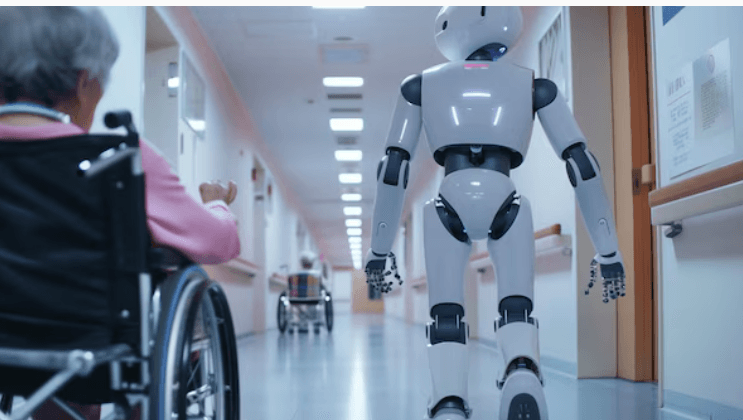
The first thing you notice when you enter one of the inner-south aged care facilities in Melbourne where Abi has been assigned is that no one treats her like a machine. She stands 110 cm tall on a spherical wheeled base, around the height of a ten-year-old. Her eyes are alive and expressive, and her frame has purposefully delicate curves with colors that fall halfway between those of a hospital fixture and a children’s toy. She addresses each resident by name. Two weeks earlier, she recalled that one of them had mentioned a daughter who lived in Sydney, so she inquires about her. Abi doesn’t miss a beat when a person transitions from English to Cantonese in the middle of a sentence.
Grace Brown and Yan Chen, two engineers, launched Andromeda Robotics, the Melbourne business that created her, in 2022 with the goal of addressing an issue that Australia’s senior care industry finds difficult to discuss openly: a labor shortage that is widening. By 2030, the nation is expected to experience a shortfall of at least 110,000 direct aged care professionals. The math is simple yet painful. an aging population, a labor market that is unable to quickly fill care positions, and a standard of care that is highly dependent on regular human attention. Abi was created to address the aspect of the issue that is often disregarded in policy discussions: loneliness rather than physical tasks.
The language data that has surfaced from Abi’s deployments at Medical & Aged Care Group locations throughout Victoria reveals a narrative that the company’s designers were not entirely prepared for. Eighty-eight percent of the 104 observed sessions from early 2024 to the end of 2025 featured a resident speaking a language other than English. Aged care facilities in Melbourne’s suburbs represent the city’s true multilingualism, but the care staff frequently doesn’t, at least not in the languages that people prefer to speak when they’re worn out, perplexed, or just nostalgic. In certain situations, Abi’s 90-language support isn’t a selling point. It’s a certain type of access.
Consultants from Pixar and DreamWorks were involved in the body language and animation design, which may seem strange until you consider why humanoid robots are unable to empathize with humans. Failures of craft as much as engineering include the uncanny valley, the slightly off timing of movements, and the facial expressions that appear incorrect rather than neutral. In a care context, a robot that was engineered to be emotionally readable would be more valuable than one that was optimized for any specific task efficiency, according to Brown and her team’s calculated wager. Partner facilities’ early acceptance rates indicate that the wager is profitable.
Andromeda started its U.S. launch in March 2026 after closing a $17 million funding round. Production will soon reach 100 units per month. As comparable initiatives from China, South Korea, and Japan entered the same market from other sides, the global eldercare robot market was estimated to be worth $3.56 billion in 2026 and was expanding at a rate of around 12% per year. Although none of them are precisely like Abi—the majority of rival robots prioritize medication reminders or physical aid over fostering relationships—the market framing is getting more competitive.
