

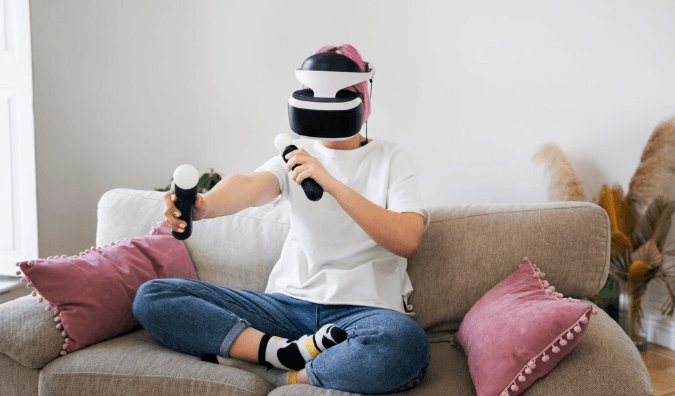
Recalling the Virtual Boy makes me feel almost uneasy. Not only because of what it was, but also because of the way it felt. A flickering red void that pulsed between fascination and headache replaced the outside world as you leaned forward and pressed your face into that black plastic visor. It wasn’t particularly enjoyable. However, it was also not unforgettable.
The Virtual Boy was marketed as a preview of the future when Nintendo released it in 1995. The futuristic sound of a 32-bit console with stereoscopic 3D capabilities justified its peculiar design. However, the reality was much less compelling. The screen was a harsh red glow. The gadget was not really portable. The games seemed constrained. It vanished in less than a year.
| Category | Details |
|---|---|
| Console | Virtual Boy |
| Company | Nintendo |
| Original Release | 1995 |
| Discontinued | 1996 |
| Units Sold | ~770,000 |
| Technology | Stereoscopic 3D (red monochrome display) |
| Key Issue | Eye strain, discomfort, limited games |
| Comeback | 2026 as Switch/ Switch 2 accessory |
| New Offering | 14 classic games, $100 replica device |
| Reference | https://en.wikipedia.org/wiki/Virtual_Boy |
Nevertheless, there’s a feeling that Nintendo saw something in it that others overlooked when they brought it back in 2026—not as a complete console, but rather as an intriguing add-on for the Switch. Or perhaps there’s something it still doesn’t fully understand.
In many respects, the original machine was a compromise. The Game Boy’s engineer, Gunpei Yokoi, based it on the idea of creatively utilizing less expensive, older technology. That was one of the reasons it was all red. The cost of color displays was prohibitive. Red LEDs worked well. sensible choices, at least in writing.
However, it had an odd effect when I watched someone try it for the first time in a retail setting in the mid-1990s. Strangely hypnotic, but not as immersive as contemporary VR promises. Mario’s Tennis features a floating tennis court that is suspended in the dark. It’s difficult to ignore how silent those times seemed, as though the machine was more interested in staring than playing.
The timing of the Virtual Boy’s arrival was off. Bright, fast-paced, full-color 3D worlds were being pushed by Sega’s Saturn and Sony’s PlayStation. Richer experiences were available with Nintendo’s own lineup, which included the Super Nintendo and the upcoming Nintendo 64. A red-and-black headset on a table felt… unfinished against that background.
Players and investors responded appropriately. Sales became stagnant. Reviews became doubtful. It didn’t help to hear about headaches and eye strain. These worries became a part of the device’s identity, though it’s still unclear if they were overblown or just inevitable given the design. A console that was literally painful to operate.
Nintendo’s past exhibits a pattern of failures that subtly influence subsequent achievements. The company’s interest in 3D did not end with the Virtual Boy. The Nintendo 3DS, which offered depth without requiring players to bury their faces in a machine, would revisit the concept years later with greater refinement. Eventually, even that feature was reduced.
As this has been going on for decades, it seems that Nintendo views its mistakes more as incomplete concepts than as errors.
That pattern is consistent with the 2026 revival. Nintendo is reintroducing the Virtual Boy as a piece of history, an accessory, a curiosity, and a way to revisit past experiments without fully committing to them again, rather than pretending it was something it wasn’t. A copy made of plastic. A cardboard version. From a catalog that used to seem insignificant, fourteen games were selected.
Perhaps the majority of this work is being done by nostalgia. Due to players’ desire for unique, even awkward, experiences, retro gaming has grown into a separate industry. The Virtual Boy provides something that contemporary games seldom do: constraint, thanks to its peculiar ergonomics and constrained color scheme.
Immersion technology—VR headsets, augmented reality, and mixed reality devices that promise deeper engagement—has been a recurring theme in the gaming industry. The majority of them are more sophisticated than anything Nintendo tried in 1995. Adoption is still uneven, though. Uncertain use cases, expensive hardware, and sporadic discomfort. Repeating themes.
From that perspective, the Virtual Boy seems more like an early draft than a failure.
The realization that innovation doesn’t proceed in a straight line occurs at a point that is frequently disregarded. It repeats itself. It comes back. It makes another attempt, a little differently. There’s a sense that Nintendo is recognizing this loop as they bring this device back—not to dominate the market, but to exist again.
The majority of businesses bury their mistakes. Putting one on the shelf and reselling it seems to be Nintendo’s way of saying, “This mattered, even if it didn’t work.” That level of confidence is uncommon. Or perhaps a form of obstinacy.
Whether anyone will use the new Virtual Boy for longer than a few minutes at a time is still up in the air. Long sessions weren’t intended for the original, and it doesn’t appear that the new versions will change that. However, that may not be the purpose.
There is an odd continuity between the past and present when you stand in a room, hold a contemporary console up to your face through a piece of cardboard or plastic, and watch red shapes float in the dark. A reminder that traces can be left by even the most uncomfortable ideas.
And sometimes it’s worth going back to those traces.
