

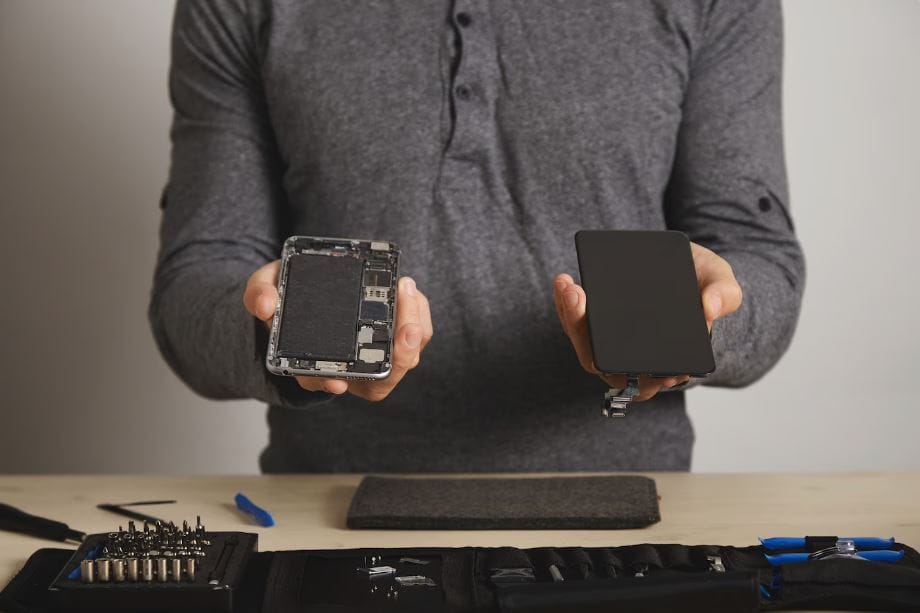
Apple would prefer you to forget about the repair shop at the end of the block for years. The authorized-only service agreements, software locks, and proprietary screws were all intended to direct you back toward the Apple Store, where fixing a cracked back glass on a modern iPhone could cost $599. That is about half the cost of the phone. For many, the math was never difficult. They recently purchased a new one.
E-waste has become the world’s fastest-growing waste stream in large part because of this calculation, which is repeated across hundreds of millions of devices. Less than 20% of the more than 57 million tonnes of it we produced in a single year were recycled, making it heavier than the Great Wall of China. About two more tonnes of CO2 are released for every tonne that is not recycled. The figures are astounding, and somewhere in the middle of that heap is a generation of iPhones that were never fixed because fixing them was made purposefully difficult.
Because of this, Apple’s change, which is deliberate, slow, and obviously reluctant, seems like something to be aware of.
The company declared that it would start selling parts to individual customers, beginning with screens, batteries, and cameras for more recent iPhone models. The initiative began in the United States and is intended to spread abroad. Even the partial opening is noteworthy coming from a company that spent years using lobbyists to argue that independent repairs were risky, even though it’s a smaller concession than repair advocates had pushed for. It turned out that Apple’s service revenue was primarily at risk.
With his usual directness, Steve Wozniak stated as much. In a video produced for repair activist Louis Rossmann, the co-founder of Apple, who is still officially employed by the company and receives a symbolic $50 weekly check, claimed that control, not safety, had always been the reason behind Apple’s resistance to repair. He remembered experimenting with TV schematics that he was never denied access to in order to construct the Apple I. The Apple II came with its own schematics. He claimed that for ten years, Apple’s profits came solely from this transparency. He was aware of the irony of the company’s current stance.
The Federal Trade Commission unanimously voted to encourage tech companies to relax repair regulations as part of the Biden administration’s pressure campaign. In a similar vein, European regulators were pushing for repairability disclosures and requiring standardized charging ports. Even though it arrived at the door a little late, Apple’s eventual support of California’s right-to-repair bill and its public call for a national equivalent suggested the company had read the room.
But opening the door and keeping it wide open are two different things. Apple’s self-repair program still necessitates buying parts at prices that aren’t always competitive, according to critics, and the authentication software Apple uses for some repairs is still strictly regulated. The concession is significant but not definitive, according to the Repair Association, which has been involved in this conflict for longer than most people have been aware. That seems to be about correct. It’s not the wall collapsing, but rather a crack in the wall.
However, something has changed. The debate over who actually owns a device after it is sold—that is, who can alter, repair, or prolong its life—has shifted from the periphery to the mainstream. According to surveys conducted in the UK, almost one-third of consumers were throwing away their phones because they thought repairs would be difficult or too expensive. That is not a small inefficiency. That system was intentionally designed to fail.
As this develops, it’s difficult not to think that the right-to-repair movement has earned something tangible—a precedent rather than a revolution. Additionally, just like in the legal system, corporate behavior precedents tend to spread.
