

A server room has a certain type of silence. There was a constant drone of cooling fans operating against tens of thousands of GPUs arranged floor to ceiling, but there was no hum of conversation. That quiet is doing something pretty amazing at Argonne National Laboratory outside of Chicago: it’s enabling researchers to search through 50 billion molecules in roughly the same amount of time as brewing a pot of coffee. Specifically, twenty minutes. One researcher there said that screening even a billion compounds in that window would have been simply unimaginable on older machines.
It’s easy to think of cancer research as a tale of intelligent people bent over microscopes. That picture isn’t entirely incorrect, but it’s lacking. Crowds are becoming a bigger part of the real story. At locations like Oak Ridge, Denmark’s Computerome, or Argonne’s Aurora system, that crowd can occasionally be silicon—racks of processors. For a few pennies per task, or sometimes nothing at all, regular people who were recruited online squint at biopsy images on their laptops to classify tumor cells. The two types of crowdsourcing have quietly converged on the same issue, and the outcomes are beginning to resemble a real change in the way the illness is researched rather than merely incremental advancements.
Think about the “undruggable” proteins—a term that sounds almost theatrical until you know what it means. These proteins, which have been linked to the development of tumors, have withstood decades of chemical assault; one scientist at Argonne compared them to “a piece of chewed-up gum, full of little pockets and crevices.” For years, scientists have struggled to find a molecule small enough and precise enough to fit into one of those pockets. The proteins are not altered. The instruments are the problem. Scientists can simulate those wrinkled structures atom by atom and then search vast chemical libraries for something that might fit by combining AI models with exascale computing.
Distributed human intelligence, on the other hand, has been quietly working in the background. According to a 2017 systematic review, regular volunteers who were primarily recruited via websites like Amazon Mechanical Turk were able to classify the estrogen receptor status of breast cancer biopsies with accuracy that was comparable to that of pathologists with training. The review was cautious not to replace the experts, but to approximate their judgment sufficiently to be significant. Sitting with a parent in Ohio during their lunch break while viewing a stained tissue sample on a screen and making a tiny contribution to a diagnostic pipeline that may one day aid a stranger is an odd experience.
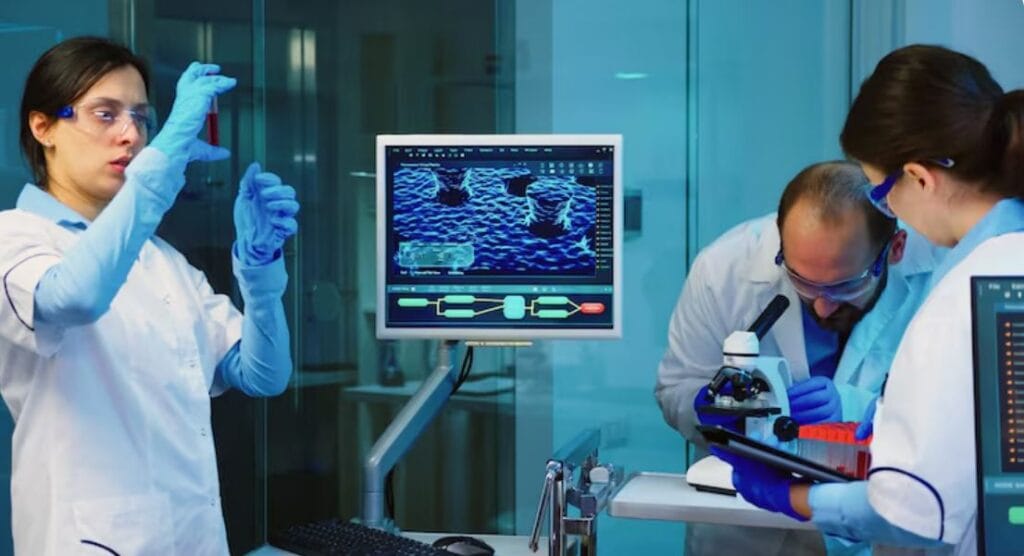
The sheer impatience of those in charge of these initiatives and their scale are what bind them together. From an initial target to FDA approval, drug discovery has historically required up to fifteen years and more than two billion dollars. Fifteen years is not an option for patients. Collaborations like the one between Argonne and the University of Chicago Medicine Comprehensive Cancer Center, which was founded on ovarian cancer—a disease that is notoriously aggressive and resistant to treatment—are motivated by this urgency and are intended, according to their leaders, to eventually apply to other cancer types.
The scientists involved feel that something has actually changed, not just in terms of computing power but also in terms of confidence. Undruggable targets were treated for years as an acknowledged medical limit, practically a permanent fixture. The idea of cracking them is now being discussed cautiously. It’s unclear if this optimism will endure contact with clinical trials; AI has overpromised in the past, both in cancer research and other fields, and skepticism appears to be justified alongside the enthusiasm.
It’s also important to note how unglamorous the majority of this work actually appears on a daily basis. There were only small improvements—models that were assessed, reassessed, rejected, and enhanced—rather than significant discoveries that were made public at press conferences. Researchers describe a ten-year arc that began around 2016 and went from developing AI tools to evaluating an overwhelming proliferation of them, then returning to building, this time focusing on issues that were previously thought to be insurmountable.
It remains to be seen if crowdsourced supercomputing will eventually change cancer treatment in the same way that the human genome project changed genetics. However, it’s difficult not to feel that something long-lasting is being constructed, one molecule, one pixel, one protein at a time, as you watch the parts come together—citizen scientists, exascale machines, ultrabright X-rays, decades of patient data.
