

It has an almost paradoxical quality. Large quantities of something as basic as water are required by the machines that create the most advanced technology in the world, such as the chips that drive AI models, smartphones, satellites, and surgical robots. Each facility uses millions of gallons every day. Furthermore, there is simply not enough of it in the areas where those facilities are being constructed.
This is not a problem that will easily be resolved in ten years, according to some analysts. Quietly, it’s already happening in France, Taiwan, and Arizona. Roughly 40% of all existing semiconductor manufacturing facilities are situated in watersheds that are expected to experience high or extremely high water stress by 2030, which is a startling statistic. Even more concerning is the fact that more than 40% of the facilities that have been announced since 2021—the new ones, the investments intended to secure the chip supply chain—are being constructed in those same vulnerable areas.
The irony in that is difficult to ignore. Water isn’t only used to cool equipment in semiconductor factories. It directly contributes to the manufacturing process by cleaning wafers in between the hundreds of exact steps needed to construct a modern chip.
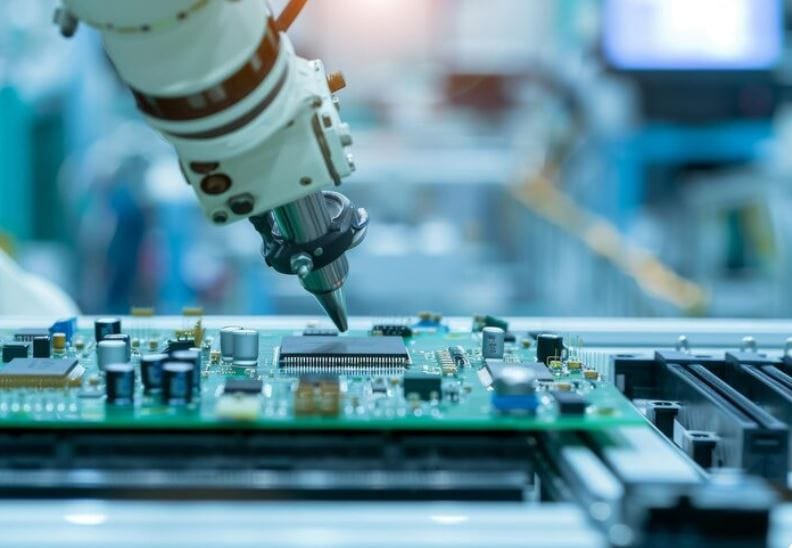
The water used must be nearly impossible to purify, or what the industry refers to as Ultra-Pure Water, or UPW, which is essentially devoid of all impurities, dissolved minerals, and trace elements. It requires a lot of energy and technical skill to produce on a large scale. And the market for it is only getting bigger. Water consumption in semiconductor manufacturing is predicted by IDTechEx to nearly double by 2035. TSMC reported using about 101 million cubic meters of water in 2023 alone. It’s not a rounding error. That is a mid-sized city’s water budget.
The most obvious and urgent example of this tension is Taiwan. The island, which produces about 90% of the most sophisticated chips in the world, has been experiencing drought since 2021. Climate models increasingly identify watersheds as vulnerable for TSMC’s most important factories, such as Fab 15, which is the only supplier of processors for Apple’s iPhone. For something like Apple’s primary chip, there are significant technical obstacles to changing suppliers. If a drought necessitates a reduction in production, there is no simple backup plan.
In some respects, the situation in the United States is even more difficult to justify. In Arizona, which has been officially experiencing a drought since 1994, the U.S. government has committed tens of billions of dollars in public funds to construct new semiconductor factories. For many years, the Southwest has experienced a water shortage. Given how much is at stake, betting chip supply chain security on an area with a persistent water shortage is a risk that hasn’t gotten nearly the attention it merits.
The friction is already apparent in Grenoble, France. Residents and STMicroelectronics have been at odds over the company’s access to the area’s water supply since 2023. This type of conflict is often presented as a neighborhood grievance or local problem, but it actually indicates something more significant. Politics quickly become chaotic when nearby communities and chip factories vie for the same water.
A few businesses are taking this seriously. Three of SK Hynix’s factories were already categorized as being in high or medium-high water stress zones, which contributed to the company’s more than 50% increase in reused water volume between 2020 and 2023. After etching, GlobalFoundries reduced rinse times by half, from ten minutes to five, and saved 10,000 cubic meters of water per year. In Texas, Tower Semiconductor came up with an inventive way to keep the dry air inside the fabrication plant by collecting moisture from the dehumidification systems. At its Hsinchu facility, TSMC has tested desalination. These are not insignificant endeavors.
However, it’s still unclear if recycling initiatives and efficiency measures can keep up with the scope of what’s coming. Reusing water is beneficial. When aggregate demand—from chips, agriculture, and a growing population—keeps increasing, it doesn’t solve the fundamental problem. The sheer volume of consumption can surpass even extremely high recycling rates.
The majority of conversations regarding the security of the semiconductor supply chain do not address this environmental reality. Geopolitics, such as Taiwan Strait tensions, export restrictions, and chip wars, are frequently brought up. These are legitimate worries. However, a protracted drought is unaffected by trade policy. Sanctions have no effect on a stressed watershed. The business community and the governments that support it may not have taken the logic of the physical world seriously enough.
The water requirements will rise, the processes will become more intricate, and the chips will continue to get smaller. It is worthwhile to consider whether the areas selected to accommodate this growth can genuinely support what is being constructed there, or if the industry is subtly preparing for a crisis that is completely predictable but, for some reason, largely unanticipated.
