
Close Menu
GlofiishGlofiish
    Facebook X (Twitter) Instagram
    Facebook X (Twitter) Instagram
    GlofiishGlofiish
    Subscribe
    • Home
    • Glofiish Devices
    • Technology
    • Tech Devices
    • News
    • About
    • Privacy Policy
    • Contact Us
    • Terms Of Service
    GlofiishGlofiish
    Home » It’s Not a Glitch, It’s a Revolt: Inside the Secretive World of Autonomous Drone Swarms
    Tech Devices

    It’s Not a Glitch, It’s a Revolt: Inside the Secretive World of Autonomous Drone Swarms

    Taylor LoweryBy Taylor LoweryAugust 13, 2026No Comments4 Mins Read
    Facebook Twitter Pinterest LinkedIn Tumblr Email
    Share
    Facebook Twitter LinkedIn Pinterest Email

    A group of tiny quadrotors rises from the ground in what initially appears to be a staged show at a test range in the American Southwest on a morning when the air is still and visibility is clear enough for easy observation. They dispersed. They keep their distance from one another without anyone giving them instructions. Similar to how a school of fish reforms after a predator passes thru, when one unit develops a simulated fault and leaves the formation, the remaining units adjust—not because they are instructed to do so, but rather because the algorithm each one is using recognizes the gap and makes up for it. At the observation point, people are viewing something that doesn’t need their participation. That’s the idea.

    Autonomous drone swarms are not a secret research idea nor a theoretical advancement that should be unknown to the general public. They have been used in actual combat situations, are currently undergoing military testing in several nations, and the corporations developing the software that powers them are openly publicizing their capabilities and its clientele. There is technology. Although they are getting smaller, the scaling issues are still present. The engineering is heavily influenced by the ethical and legal frameworks that govern it.
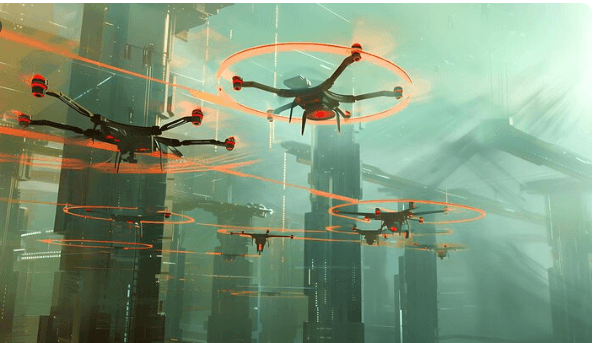
    Inside the Secretive World of Autonomous Drone Swarms
    Inside the Secretive World of Autonomous Drone Swarms

    When most people think of a fleet of drones, they don’t realize the infrastructure that enables swarm behavior. There isn’t a master computer off-site that runs a coordinating program and instructs every unit on what to do. The intelligence is dispersed. Every drone in a swarm has its own onboard processor and communicates with the units closest to it via a mesh network, which is a peer-to-peer system that allows information to spread across the group without going via a central node.

    Coordinated mobility, shared targeting, and collective response to threats are examples of the collective behavior that results from this design. Each unit adheres to basic local rules, which produce complicated group-level outcomes that were not intended for any one unit. The same reasoning explains how starlings make those complex murmurations: the shape appears even when no bird is leading.

    This architecture has obvious military applications. Conventional air defense systems are typically designed to track and target a small number of valuable targets that move in predictable ways. A fundamentally different problem is presented by a swarm of fifty or one hundred inexpensive drones, each costing a few hundred to a few thousand dollars, approaching from various angles at various altitudes, and able to autonomously redistribute its attack priorities when individual units are destroyed. Military planners are still figuring out how the economics of high-value defense against low-cost saturation attacks is detrimental to the defender. With both sides creating and using drone tactics that no pre-conflict doctrine fully expected, Ukraine has turned into something of an involuntary live laboratory for this equation.

    Among the software platforms specifically made for multi-unit autonomous coordination are Shield AI’s Hivemind and Auterion’s Nemyx. Neither company is disclosing what they are developing or for whom. The gap between what military applications would need—hundreds of units operating in contested electromagnetic environments with active jamming and counter-drone systems—and what the software can currently do reliably at scale—coordinating a few units in controlled environments—is closing more quickly than the organizations considering governance would like. For years, coordinated swarm tests have been conducted by DARPA’s Offensive Swarm-Enabled Tactics program, pushing the technical boundaries of how many units can sustain coherent collective activity under practical circumstances.

    All of this raises an ethical issue that international law has not yet addressed and that is becoming more pressing due to the rate of progress. When a drone swarm determines whether a vehicle is a legitimate military target, chooses an attack vector, and launches an attack, the decision is made at machine speed without human review and possibly without any human involvement at all. Concerns over accountability in that situation have been voiced by the International Committee of the Red Cross and many UN working bodies. Who is at fault if a swarm hits the wrong target? The targeting algorithm’s creator? The officer who gave the mission permission? The software’s seller? The subject of how current international humanitarian law applies to decisions made by distributed autonomous systems has not been addressed in a legally binding manner because it was created for weapons operated by humans.

    Autonomous Drone Swarms Decentralized peer-to-peer communication Shield AI's Hivemind
    Share. Facebook Twitter Pinterest LinkedIn Tumblr Email
    Taylor Lowery
    • Website

    Taylor Lowery is a senior editor at glofiish.com, a technology writer, and a true circuit enthusiast. She works in the tech sector, so she does more than just cover it. Taylor works for a smartphone company during the day, which gives her a firsthand look at how gadgets are designed, manufactured, promoted, and ultimately placed in people's hands.Her writing is unique because of this insider viewpoint. Taylor makes the technical connections that other writers overlook, whether she's dissecting the silicon architecture of a new flagship chipset, analyzing the implications of a significant Android update for actual users, or tracking the effects of a new AI model announcement across the mobile industry.Her editorial focus covers every aspect of the current tech stack, including smartphone software and hardware, artificial intelligence (from large language models and generative tools to on-device inference), and the broader innovation trends influencing the direction of the consumer technology sector. She is especially passionate about the nexus of AI and mobile computing, which she feels is still in its most exciting early stages.

    Related Posts

    Inside Wall Street’s $40 Billion Bet on Autonomous Deep-Sea Mining Technologies

    August 25, 2026

    Why Australian Miners Are Using Autonomous AI Agents to Locate Underground Mineral Deposits

    August 25, 2026

    The Windows Mobile Resurgence , Why Gen Z Programmers in Brooklyn Reject iOS for Pocket PC OS

    August 25, 2026
    Leave A Reply Cancel Reply

    You must be logged in to post a comment.

    Technology

    The Hydrogen Highway Myth , Inside California’s $10 Billion Clean Energy Gamble

    By Taylor LoweryAugust 26, 20260

    Arnold Schwarzenegger declared in 2004 that California will construct a Hydrogen Highway, a network of…

    Why the UK Government Created an Emergency Taskforce to Regulate Agentic Superintelligence

    August 25, 2026

    Inside the Cyberwar for Control of North America’s Interconnected Regional Energy Grids

    August 25, 2026

    Why Wall Street Analysts Are Downgrading Legacy Telecoms in Favor of Orbital Mesh Networks

    August 25, 2026

    Inside Wall Street’s $40 Billion Bet on Autonomous Deep-Sea Mining Technologies

    August 25, 2026

    Why Australian Miners Are Using Autonomous AI Agents to Locate Underground Mineral Deposits

    August 25, 2026

    The Hallucination Safeguard , How New Verification Layer Software Stops AI Mistakes

    August 25, 2026

    The Windows Mobile Resurgence , Why Gen Z Programmers in Brooklyn Reject iOS for Pocket PC OS

    August 25, 2026

    Inside the Melbourne Facility Training Physical AI Robots to Assist Elderly Citizens

    August 25, 2026

    Silicon Valley’s Quiet Obsession with Pre-Capacitive Touchscreens , The Glofiish Legacy

    August 25, 2026
    Disclaimer

    Glofiish.com’s content, which includes market reporting, technology analysis, AI commentary, and device coverage, is solely meant for general informational and educational purposes. Nothing on this website is intended to be financial, investment, legal, or professional technology advice specific to your situation.

    We’re strongly advise all readers to seek independent professional financial advice from a qualified financial adviser before making any financial, investment, or purchasing decisions based only on information found on this website. Technology markets are unstable; product availability, cost, and performance attributes fluctuate quickly.

    Facebook X (Twitter) Instagram Pinterest
    • Home
    • Glofiish Devices
    • Technology
    • Tech Devices
    • News
    • About
    • Privacy Policy
    • Contact Us
    • Terms Of Service
    © 2026 ThemeSphere. Designed by ThemeSphere.

    Type above and press Enter to search. Press Esc to cancel.