

A few months ago, there was a change on the internet that most people were unaware of. It wasn’t a dramatic change. There was neither an alarm bell nor an announcement. However, automated bots now produce more web traffic than people, according to Cloudflare’s most recent traffic report, which was released in early June 2026. The percentage is approximately 42.6 percent human and 57.4 percent bot. For the first time in its history, machines now control the internet.
Matthew Prince, the CEO of Cloudflare, appeared genuinely taken aback by the timing. He posted, “Welp, that happened faster than I predicted,” on X, which was formerly Twitter. He’d estimated the crossover wouldn’t arrive until early 2027 at the soonest. The growth of agentic AI — programs that browse websites, compare prices, scrape data, and perform complex tasks autonomously — accelerated the timeline by months. It’s possible that the actual tipping point occurred weeks before anyone at Cloudflare could pin it down. Prince admitted that the data was untidy.
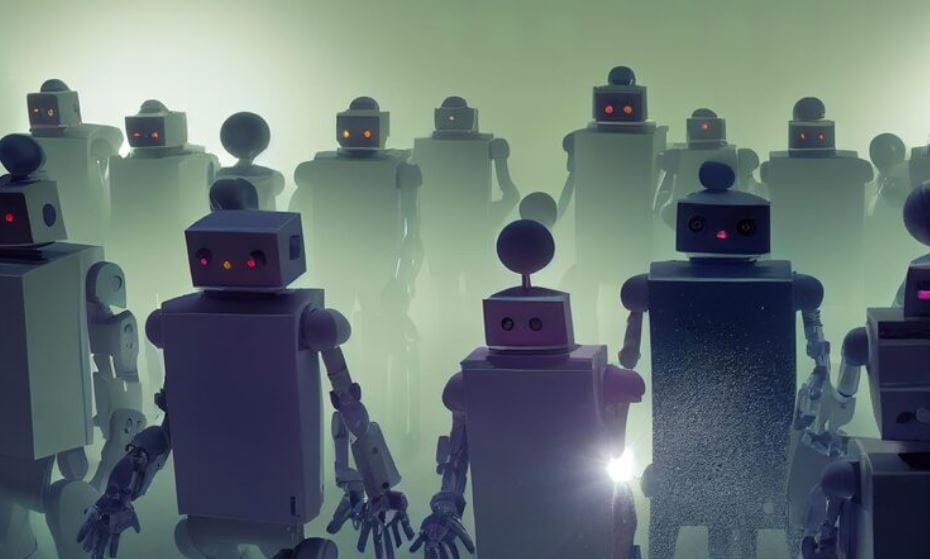
This situation had a name five years ago. It was called the Dead Internet Theory, and it lived mostly in the conspiratorial corners of forums and anonymous message boards. The original version, posted by a user called “IlluminatiPirate,” had two claims: first, that bots and algorithmically curated content had already displaced most organic human activity online; second, that state actors were orchestrating this deliberately. The second part has always sounded suspicious and continues to do so. However, the first section continued to collect evidence year after year, much like sediment accumulates along a riverbed.
It is difficult to ignore the research trail. Imperva discovered that 52% of web traffic was automated back in 2016. By 2023, their updated report placed the figure at 49.6 percent — a dip, but one partly explained by the massive surge in human activity during and after the pandemic. Everything picked up speed after ChatGPT was made available to the general public in late 2022. Large language models were no longer only business tools. Blog entries, product reviews, social media comments, and even whole news articles could be created by anybody with a browser. The flood happened quickly and was hard to quantify.
Now, when you browse some sections of the internet, you get the impression that something essential has become hollow. Major platforms’ comment sections read differently. Sometimes Reddit threads have an odd consistency, a rhythm that seems practiced. A user on the technology subreddit put it bluntly last week: “The irony of replying to this and not knowing if you’re talking to a bot is not lost on me.” Another commenter added, “If everything is a simulation, may as well keep it a positive one,” and recommended blocking anyone who appeared to be inciting anger. The humor is genuine. The uneasiness underneath it is also.
Last September, even Sam Altman of OpenAI—who isn’t exactly known for being a technophobe—acknowledged the change. “I never took the dead internet theory that seriously,” he wrote on X, “but it seems like there are really a lot of LLM-run Twitter accounts now.” The post went viral, which seemed like a minor irony in and of itself—a statement about environments dominated by machines, amplified by the platform it was about.
The sophistication involved sets this moment apart from previous waves of bot activity. Conventional bots carried out specific, repetitive tasks like scraping email addresses, posting spam, and inflating view counts. The latest generation of AI agents browses similarly to a human. They compare product specs, check airline rates, summarize articles, and bargain on behalf of customers. They aren’t always malevolent. However, they are consuming bandwidth, influencing the priorities of websites, and progressively changing the web’s architecture. By 2030, Goldman Sachs predicts a 24-fold increase in token usage, which raises concerns about whether publishers and retailers will require different layers—one for humans and one for machines.
Whether this is a crisis or just an evolution is still up for debate. According to data from Cloudflare, between 75 and 80 percent of traffic on Iran’s internet is bot-related, and a large portion of this traffic is probably related to state-sponsored hacking activities. On the other end of the spectrum, Israel has about 18% bots, with occasional spikes during alleged foreign cyberattacks. Bot activity’s geographic distribution reveals an unsettling tale of its own.
It’s difficult not to wonder what the internet is evolving into as you watch all of this happen. Not really dying. But transforming into something that wasn’t intended for us, or perhaps it wasn’t intended for anyone.
