

A structure the size of several football fields exists somewhere in the desert outside of Phoenix, Arizona. It never goes dark and hums nonstop. It is a data center that uses enough water to fill multiple Olympic swimming pools and enough electricity to run a small city each day. It appears to be a warehouse from the roadway. It appears to be an increasing issue from the standpoint of the electricity system.
The environmental cost of the AI boom has been growing for years; it has been debated in technical circles but has not received much attention from the general public when discussing the practical applications of artificial intelligence. The figures that have surfaced from 2025 are specific enough to be hard to ignore. Last year, 448 terawatt-hours of electricity were used by data centers worldwide. 1.2 trillion gallons of water were consumed. They emitted 208 million tons of CO2. These numbers represent not just AI in particular but the entire data center ecosystem; however, a large amount of the demand growth is being driven by the rapid expansion of AI workloads, which makes the 2030 projections of 945 terawatt-hours—roughly twice the current figure—seem reasonable rather than alarming.
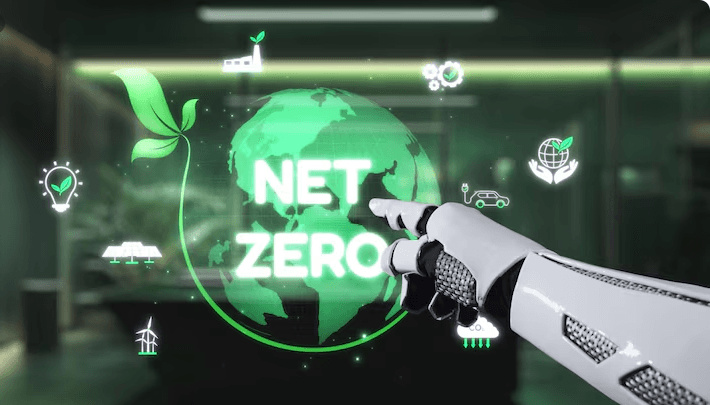
The subject about electricity use receives the most attention, in part because it relates to the public climate pledges made by big internet corporations for years. Amazon, Google, and Microsoft have all made net-zero commitments with deadlines. The same AI investment choices that their investors are applauding are putting pressure on those vows. Large language models need a lot of processing power to train; a large model’s training run can use as much electricity annually as hundreds of families. After that, the model continuously processes millions of queries, each of which is tiny but the total is significant. When demand increases more quickly than renewable power can be added to the grid, whatever is available on the grid—which in many places still means coal or natural gas—fills the gap.
Although it is probably more immediately consequential for certain populations, the water dimension receives much less attention. Heat-producing servers need to be cooled, and the most popular industrial cooling technique is water-based. Five million gallons of water can be drawn daily from nearby water sources by a sizable data center. These withdrawals take place in an area already dealing with chronic water scarcity in the American Southwest, where data center construction has concentrated in part due to land availability and power infrastructure. Serving what is essentially a global digital demand places a localized environmental burden on the communities surrounding these facilities.
Another factor that is rarely discussed when discussing the environmental impact of AI is the hardware supply chain. The specialized processors that power AI workloads, such as Google’s TPUs, Nvidia’s H100 and H200 series, and subsequent generations, need rare earth minerals that are mined in Indonesia, the Democratic Republic of the Congo, and other places. Local ecosystems are disturbed, water tables are contaminated, and mining populations are subjected to circumstances that the final consumers of the commodity will never witness. A Virginia data center uses materials that are taken from dirt on the opposite side of the world, and the supply chain that connects those two locations creates its own environmental accounting that is not included in the carbon disclosure of a technology business.
The waste issue is exacerbated by the rapid obsolescence of gear. Data centers are replacing equipment on cycles measured in a few years rather than a decade due to the rapid advancement of AI chip generations. Hardware that is older is retired. A portion of it is recycled, but most of it ends up in the world’s electronic waste stream, which is expected to grow to 2.5 million tonnes annually from AI hardware alone by 2030. In many of the areas where it is concentrated, the processing of e-waste is toxic in and of itself.
All of this does not imply that the technology is worthless or that the environmental cost cannot be controlled. It indicates that the cost of the AI boom is real, exists, and is now underestimated in the public accounting. As this discussion progresses, there’s a sense that a reckoning is imminent, that the disparity between the industry’s sustainability pledges and the trajectory of its actual resource consumption will eventually become too obvious to discuss. The question is whether industry voluntary action, governmental pressure, or the real constraints of the grid and water systems themselves are responsible for the response.
