

Before environmental issues become popular, there is a certain amount of silence surrounding them. Scientists were already discovering single-use plastics in deep ocean sediment ten years before they were discussed at dinner tables. Something that people carry in their pockets on a daily basis seems to be the focus of that same silence.
Microplastics are being released by your smartphone, or more precisely, by the plastic case that surrounds it. continuously. into the air, against your palm, and onto objects you come into contact with. According to a 2022 study that was published in the Journal of Hazardous Materials, phone case surfaces had average abundances of about 1,122 microplastic particles per square centimeter, with about 314 particles per square centimeter moving to the palm during regular use. These are not lab numbers that are abstract. That’s what’s going on in your hands at the moment—during a commute, at a coffee shop, or at a child’s dinner table.
The particles in question are small, with median sizes between 28 and 32 micrometers, which is smaller than what previous research in related fields had generally reported. Because smaller particles can pass through more readily, size is important in this situation. They settle on food, pass through skin, and float in indoor air. According to the same study, significant particle generation can start as early as 33 days after a case is used, and the main causes of shedding are friction and UV exposure from daily use. Compared to that, most people exchange cases much less frequently.
Because phone cases occupy such a specific blind spot in our understanding of plastic pollution, this is especially hard to overcome. Images of sea turtles, floating bottle caps, and volunteers wearing rubber gloves cleaning up the coast are examples of the visual grammar our culture has created for plastic waste.
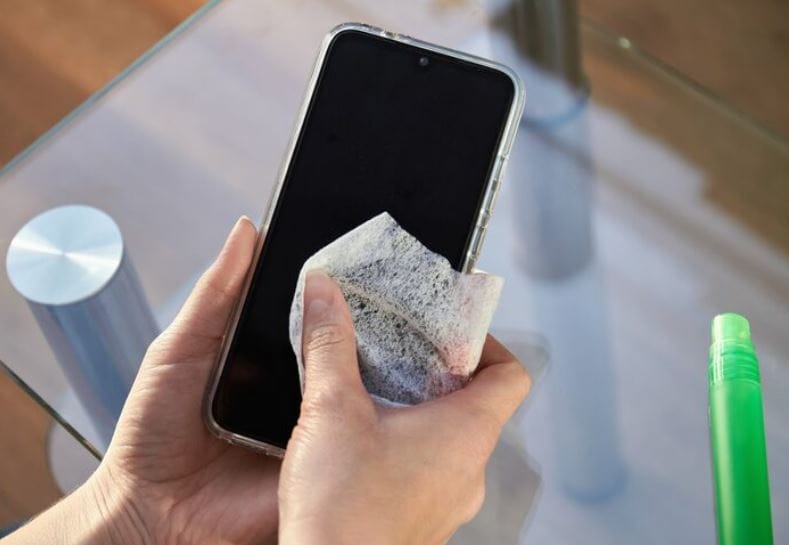
Phone cases don’t match that perception. They are attached to a product that society views as progressive, are slender, and are frequently marketed as fashionable or sustainable. While the $10 TPU case that protects that aluminum chassis receives virtually no environmental scrutiny, the tech industry has spent years projecting an image of clean, sleek minimalism—glass surfaces, recycled aluminum.
It’s important to remember that phone cases are not the only source of microplastic. Plastics are used throughout the consumer electronics supply chain, including in cables, chargers, earbuds, and packaging. Over time, a large portion of these materials deteriorate and break. According to the UN Environment Programme, microplastics can travel far beyond the room where they originated because of atmospheric deposition, runoff, and mechanical wear. It’s still unclear how much of a specific contribution phone-related plastics make in comparison to, say, synthetic textiles or tire dust. However, the evidence’s directionality is unsettling.
This story also has a detection component that is worth taking into account. In order to find microplastics as small as 20 micrometers in drinking water samples, researchers have started employing smartphone microscopy, which basically involves attaching ball lenses to phone cameras. There is an unsettling irony in the fact that the same gadget that contributes to microplastic pollution is now being used to detect it. Such a system was used in a 2024 Nepalese study to detect particles in water samples from bottles and jars, with counts ranging from 0 to 130 particles per liter. Ninety-seven percent of those particles were plastic, according to FTIR analysis. The technique shows promise for low-cost monitoring, but the necessity of it indicates how widespread the issue has already become.
About a billion phone cases are sold globally each year — a figure cited widely in sustainability discussions around the tech accessories industry. The majority are composed of TPU, polycarbonate, or other petroleum-based polymers that don’t biodegrade in a significant amount of time. Usually after a year or two, they start to crack, scratch, turn yellow, and are thrown away. It is actually understudied where they go from there and how much they break apart along the way. Although some companies are now selling products made of certified compostable polymers or plant-based materials, these products still only make up a small portion of the market compared to the massive amount of conventional plastic produced.
What seems overdue is a broader reckoning — not necessarily a panic, but an honest accounting — of what personal tech actually contributes to the microplastics problem. Conflict minerals, e-waste, and manufacturing carbon footprints have been major topics of discussion when it comes to smartphones and sustainability. These are legitimate worries. However, public discourse has largely ignored the microplastic dimension, particularly from accessories. The circular economy is a topic that is frequently discussed in the tech sector. It would be more persuasive if we discussed what is subtly affecting our hands each time we take a call.
