

The Northern Territory of Australia experiences irregular rainfall. A year’s worth of precipitation can be dumped in a few weeks during its intense, concentrated wet seasons, after which it virtually vanishes. For decades, conventional weather models have failed to accurately predict when it will arrive, how much it will fall, and how it will spread across a landscape that changes greatly over short distances. Numerical projections based on global physics equations cannot accurately reflect the patterns because they are too local, too complicated, and too sensitive to the Indo-Pacific ocean-atmosphere interactions.
This is one of the reasons agricultural scientists who keep a close eye on this field were interested in research that was published in a Springer Nature journal in February 2026. Using stations like Warruwi on the Cobourg Peninsula and historical records dating back to the 1930s, a team working on rainfall prediction in Australia’s Northern Territory developed a hybrid model that combines wavelet signal preprocessing with a Long Short-Term Memory neural network. In comparison to solo models, the so-called W-LSTM system achieved correlation scores between 0.86 and 0.95 and decreased forecasting error by up to 89.6%. These figures are noteworthy in an area where millions of hectares of agriculture can make better water management decisions with even minor increases in forecast accuracy.
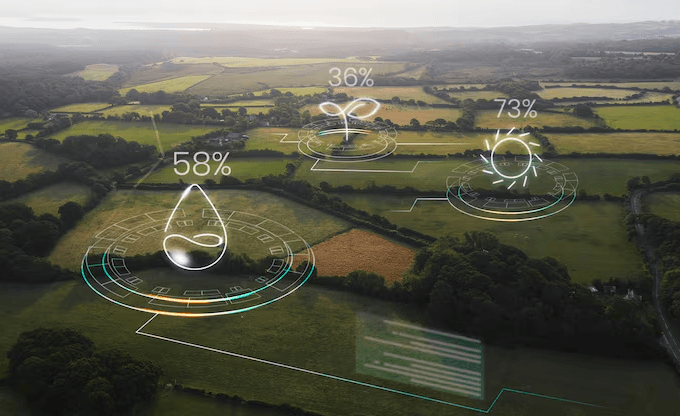
The architecture differs from a traditional deep learning approach to rainfall because of the wavelet component. It is challenging for a neural network to acquire stable prediction correlations because raw rainfall time series data is incredibly noisy, with seasonal cycles, long-term climatic signals, and short-term oscillations all superimposed on one another. These signals are separated via wavelet decomposition. Instead of attempting to learn from a single chaotic signal, it allows the LSTM to concentrate on the underlying patterns at various timescales by breaking the raw data into frequency components, much like a prism splits white light into its component colors. The study discovered that the Daubechies wavelet performed best across all tested configurations. It is especially good at detecting sudden changes in rainfall behavior, which is exactly what the monsoon-dominated environment of the Northern Territory generates.
The time aspect of the issue is handled by the LSTM itself. These networks are particularly adapted to the type of month-by-month development that characterizes the wet season build-up because they were built for sequential data and retain a sort of memory of past conditions while processing more recent inputs. The model may predict wet season behavior well in advance of the season itself when it includes lagged ENSO indices, which are measurements of El Niño and La Niña conditions in the Pacific that affect Australian rainfall months before their impacts manifest locally. That advance notification has significant economic significance for a farmer in the Top End who is choosing whether to invest in flood prevention ahead of a heavy wet season, when to sow, or how much water to give to irrigation equipment.
It is important to note that research accuracy numbers such as these do not automatically transfer into useful forecasting tools. A significant scientific finding is an R2 of 0.86 to 0.95 obtained on a historical test dataset for particular Northern Territory sites. A deployed system giving those figures across diverse agricultural areas in Western Queensland, the Riverina, or the Wheatbelt is not the same. Integration with real-time sensor networks, user-facing decision interfaces, and validation across the regional diversity that makes Australian agriculture so difficult to forecast in the first place are necessary to transform a research model into something farmers can actually use. It’s really difficult, and the job is ongoing.
The field as a whole is advancing swiftly. The amount of study attention this design has garnered is demonstrated by the 150 percent increase in LSTM-related rainfall prediction studies between 2023 and 2024 alone, according to Web of Science data. Similar precision is being produced in parallel work by GRU networks, a related architecture with lower processing needs. Studies published in 2024 and 2025 demonstrate additional error reduction using ensemble approaches that incorporate various model types, such as ridge regression meta-learners sitting on top of multiple recurrent networks. There is no doubt about the direction of travel. It remains to be seen if this research impetus will result in implemented instruments that alter the way Australian farms handle water in the next five years, but the technical groundwork being established is stronger than it was ten years ago.
