

Even though Elon Musk’s Colossus data center in southwest Memphis is enormous—more than a dozen football fields crammed together—it’s not the first thing you notice when you walk up to it. It’s the odor. Before you even see the structure, a slight chemical itch slides into your throat. Natural gas and soot. The unseen aftermath of industrial ambition at full speed. Memphis Community Against Pollution’s director, KeShaun Pearson, saw it right away. He’s been observing it for some time now.
That building is at the heart of something far bigger than a technological boom, as are thousands of similar structures being built across the United States at a rate that has no true modern precedent. It’s the physical setup of a geopolitical struggle, the new Cold War, with server rooms and semiconductor supply chains serving as the battlefields in place of missile silos and nuclear testing facilities. Observing it from the ground level makes it evident that the majority of people are still unaware of what is truly being constructed. What’s more crucial is how much it costs them.
Key Facts & Context
| Topic | The U.S.–China AI Arms Race & Data Center Expansion |
|---|---|
| Key Players | xAI (Elon Musk), OpenAI, Amazon, Meta, Microsoft, Google; China’s state-backed AI programs |
| Flagship Facility | Colossus — xAI data center, southwest Memphis, Tennessee. Annual power draw equivalent to 200,000 American homes |
| Combined Capital Expenditure | Amazon, Microsoft, Meta & Google have spent over $600 billion on data centers since ChatGPT launched in November 2022 |
| Energy Impact | Data centers now account for ~4% of energy demand in some U.S. regions; electricity shutoffs due to unpaid bills projected at 4 million households in 2025 |
| Military AI Race | U.S., China, Russia, Ukraine, India, Israel, Iran, France, Germany, Britain & Poland all investing in autonomous AI weapons and drone systems |
| China’s Strategy | Building a countrywide network of smaller data centers to compensate for chip export restrictions imposed by the U.S.; released DeepSeek as a compute-efficient rival model |
| Key Reference | NYT — The Escalating Global A.I. Arms Race (April 12, 2026) |
| Environmental Concern | 160+ new AI data centers built across the U.S. in three years, many in water-scarce regions; xAI’s Memphis facility operates up to 35 natural-gas turbines |
OpenAI has revealed plans for data center facilities that will require a total of more than 30 gigawatts of power, surpassing the highest peak demand ever recorded for all of New England. Even after accounting for inflation, the total amount spent by Amazon, Microsoft, Meta, and Google since the launch of ChatGPT in November 2022 has exceeded $600 billion, primarily on data centers. This is more than the amount spent by the US government to construct the entire interstate highway system. These investments go beyond technology. One climate modeler from Princeton described them as “the largest single points of consumption of electricity in history.” It’s amazing to say that about something that most people engage with by asking a question in a chat window.
The geopolitical story and the energy story are inextricably linked. President Xi Jinping, Vladimir Putin, and Kim Jong-un witnessed Chinese forces demonstrate drone models that could fly autonomously alongside fighter jets in combat during a military parade in Beijing last September. Afterwards, Pentagon officials came to the conclusion that China’s unmanned combat drone program was ahead of America’s. In a matter of months, Anduril, a California defense startup, was producing AI-powered self-flying drones outside of Columbus, Ohio, three months ahead of schedule, filling a void that had appeared covertly and virtually unnoticed by the public.
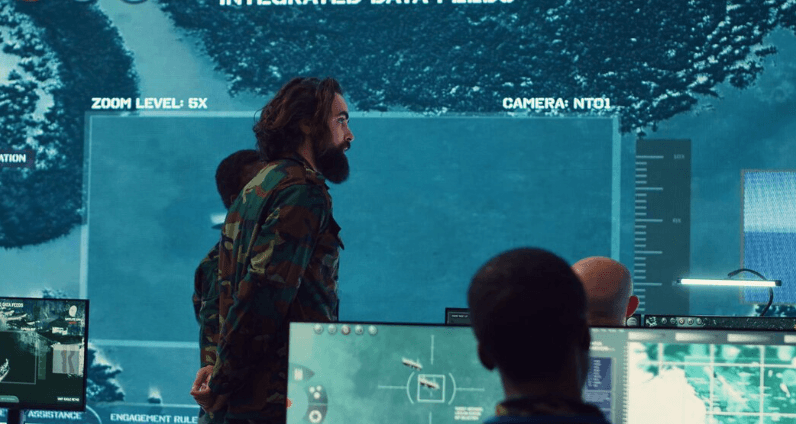
The drone show in Beijing might have been partially staged. Military parades frequently are. However, it’s more difficult to ignore this larger pattern. The two biggest military powers in the world, the United States and China, are at the center of an expanding competition for AI-backed autonomous weapons, such as self-flying fighter jets, drones that can locate and attack targets without human guidance, and central AI systems that evaluate intelligence and suggest airstrike targets almost instantly. The conflict between Russia and Ukraine, which has lasted five years, has turned into a real-world testing ground for precisely this kind of technology. Poland, Germany, Britain, and France are rearming. Iran, Israel, India—the list keeps getting longer.
Because it has the most advanced semiconductor manufacturing techniques and chips are the foundation of nearly every major advancement in AI, the United States has been able to sustain its AI advantage. Most people agree that one of the most significant trade decisions the United States has made in the current era of tech competition was to limit chip exports to China. In order to make up for what it is unable to import, China is reacting in a manner typical of a constrained power: it is creating a dispersed national network of smaller data centers, creating workarounds, and creating more effective models that maximize the capacity of scarce computing resources. It’s catching up. Perhaps not as quickly as some fear, but more quickly than the United States appeared to anticipate.
People back home who have no interest in the outcome of the AI race are paying the price for all of this. In August, energy costs in New Jersey increased by 19% over the same month last year. According to one organization, there may be 4 million power outages nationwide due to unpaid bills, up from about 3.5 million the previous year. The Trump administration has been urged by Democratic senators to provide an explanation of how it intends to shield citizens from the effects of data center demand on prices. Data centers used to consume almost nothing, but in some places they now account for nearly 4% of all energy consumption, and that number is expected to rise significantly.
There’s a feeling that the public hasn’t yet fully absorbed the significance of this moment. The framing of the arms race seems abstract. The data centers seem like a far-off industrial tale. However, there is a real electricity bill on a kitchen counter in New Jersey. It’s also true that KeShaun Pearson got a scratch in his throat while driving past a Memphis facility that burns natural gas to train an AI model. In anticipation of a future in which conflicts may be decided by algorithm against algorithm and drone against drone, every country is vying for the most sophisticated technological arsenal. It’s still unclear if there is a finish line or if this is just the way things will be for the next century—a world in which the race never ends and fuel is always paid for by someone.
