

For the majority of 2025, Anthropic’s partnership with the US Department of Defense appeared to be a model for potential collaboration between AI firms and the government. Claude became the first frontier commercial AI model used throughout the Pentagon’s secret networks after a $200 million contract was struck in July through a collaboration with Palantir Technologies. That was an important distinction. It meant that some of the world’s most sensitive intelligence was being handled by Anthropic’s technology in physically remote locations. Additionally, it meant that the business was making money from a client who had a huge thirst for what AI could achieve and nearly infinite resources.
Negotiations over the Pentagon’s GenAI.mil platform, a government-certified AI hub intended to disseminate cutting-edge AI capabilities across military personnel and contractors, began to strain the partnership in the fall of 2025. In essence, the DoD intended Claude to be able to be used for “any lawful purpose.” Anthropic drew two clear lines but generally agreed. Claude would not be utilized to control autonomous deadly weapon systems, which would make AI-driven targeting judgments without significant human supervision.
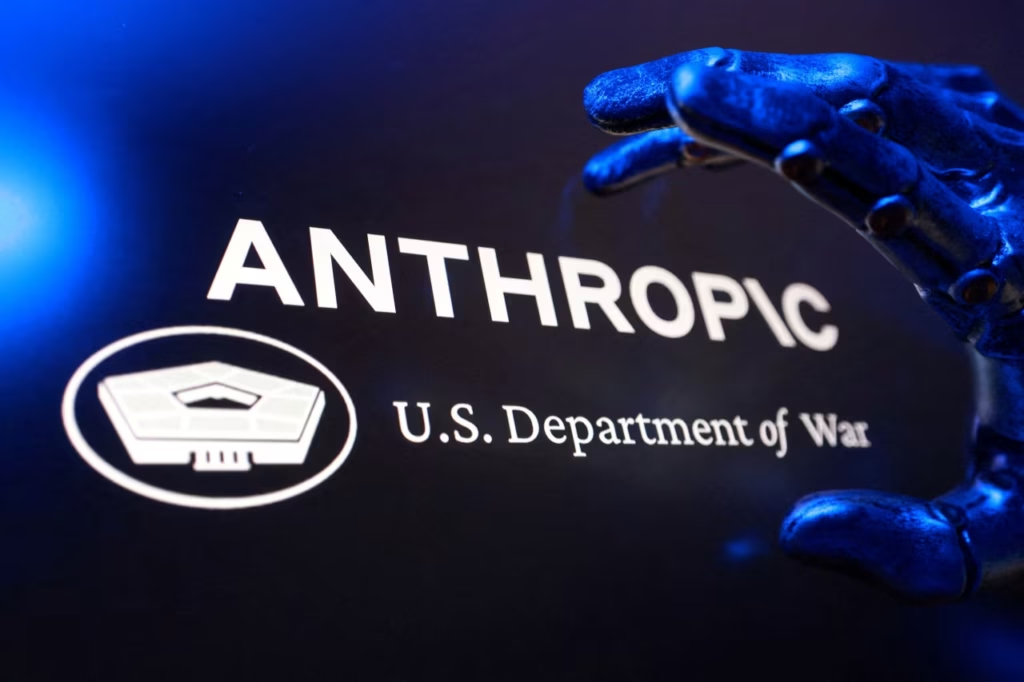
Additionally, it would not be employed for widespread domestic surveillance of Americans. These jobs weren’t brand-new. Since the company’s founding, Anthropic has incorporated safety promises into its fundamental policies, and CEO Dario Amodei has made these commitments clear in public. However, the posts were seen as an intolerable restriction coming from the wrong direction within the Pentagon.
Following an operation in January 2026, everything became much more focused. Claude assisted U.S. forces in organizing and carrying out Operation Absolute Resolve, an operation to apprehend Nicolás Maduro, the president of Venezuela. Concerned about the direct application of their technology in a critical international military action, Anthropic contacted Palantir to voice its concerns. That approach was seen by the Pentagon as an attempt by a commercial enterprise to question a national security decision. Pete Hegseth, the secretary of defense, issued a warning: either take down the barriers or the partnership will terminate. Anthropic declined. According to widely circulating reports, the chief of staff labeled Amodei as having a “God complex” during internal meetings.
Hegseth issued an order on February 28 categorizing Anthropic as a national security “supply chain risk”—a designation the government usually saves for businesses connected to the Kremlin or hostile foreign governments like Huawei. Depending on who asked, applying it to a California AI startup that opposed warrantless domestic surveillance and autonomous weapons was either a serious abuse of a crucial legal designation or a principled national security assessment. Shortly later, Trump posted on Truth Social directing all government departments to cease using Claude right away. The $200 million deal was terminated. Officials described the August 2026 deadline for DoD teams to completely move away from Claude as a significant operational nightmare.
On March 9, Anthropic filed a lawsuit, claiming that the supply chain designation was illegal and infringed against its constitutional rights. The fullest form of the ban was blocked by a preliminary injunction issued by a federal judge in San Francisco, which stopped the government from expanding the prohibition to non-defense entities. However, the DC Circuit Court of Appeals refused to suspend the Pentagon’s designation, therefore Anthropic is legally prohibited from entering into defense contracts while the legal matter is being heard. Beneath the legal battle, there is also a clear contradiction: according to reports, the NSA has continued to use Claude through its Mythos cybersecurity program, while the Pentagon continues to retain its blacklist. It appears that the coordination between the left and right hands is lacking.
The effects on the market moved swiftly. Without the legally binding usage limits that Anthropic had demanded, OpenAI was able to reach an agreement with the Pentagon. xAI and Google came next. About 80% of Anthropic’s income comes from business clients, so losing the defense contracting pipeline and the signal it sends to other big institutional clients is a big deal. One unanswered question—possibly the most important one—is whether the business can maintain that position financially while the lawsuit is pending.
