

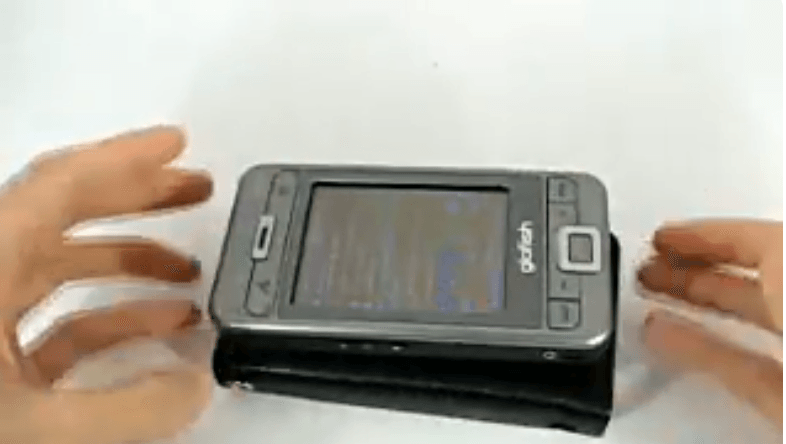
Credit: Phone Arena
The world of smartphones looked very different in late 2006 than it does now. Flip phones were still on display in stores next to bulky “PDA phones.” Styluses were widely used. Additionally, if people had navigation apps at all, they were typically housed inside clumsy GPS devices that were mounted on car dashboards. In light of this, the E-TEN Glofiish X500 was released, a gadget that subtly implied smartphones were capable of much more than just making calls.
The X500’s size was the first thing that many reviewers noticed. It was advertised as one of the thinnest Pocket PC phones that integrated Wi-Fi and GPS into one unit, measuring only 15.5 millimeters in thickness. The phone felt small but functional when held in the hand. The design of the silver casing suggested engineering practicality rather than style, giving it a somewhat utilitarian appearance.
| Category | Details |
|---|---|
| Device | E-TEN Glofiish X500 |
| Manufacturer | E-TEN Information Systems |
| Announcement | October 2006 |
| Operating System | Microsoft Windows Mobile 5.0 |
| Processor | Samsung S3C2440 – 400 MHz |
| RAM / Storage | 64 MB RAM / 128 MB ROM |
| Display | 2.8-inch QVGA touchscreen (240×320) |
| Camera | 2 MP camera |
| Key Features | Built-in GPS, Wi-Fi, FM radio |
| Battery | 1530 mAh removable Li-Ion |
| Weight | 146 g |
| Reference | https://www.gsmarena.com/eten_glofiish_x500-1764.php |
In 2006, you might have seen engineers leaning over demo tables at a technology expo, tapping styluses on screens as tiny GPS maps appeared. Those moments were made possible by devices such as the X500. It included a SiRF Star III GPS receiver, which was regarded as serious gear for navigation enthusiasts at the time.
The idea of someone standing on a street corner in a strange city, taking the phone out of their jacket pocket, has a certain allure. They could just open a GPS app instead of unfolding a paper map or mounting a heavy navigation device to the windshield. For many users, the X500 may have been the first phone that actually made it easier for them to navigate.
A 400 MHz Samsung CPU, 64 MB of RAM, and 128 MB of internal storage were installed by E-TEN inside the device. These figures now sound modest, almost charming. However, they were quite common for Windows Mobile devices at the time. Windows slid into view after a second or two, and applications opened with a slight pause. Nothing seemed to happen instantly, but the system continued to advance in general.
The phone was running Windows Mobile 5.0, a platform that viewed smartphones less like lifestyle devices and more like pocket computers. It was like entering a miniature desktop environment when the device’s interface was opened. Task lists, file folders, spreadsheets, and emails were all housed inside layered menus. That intricacy held an odd allure for tech enthusiasts and business travelers.
It wasn’t always elegant, though.
Reaching for the stylus that was kept in the phone’s corner slot was typically required in order to use the touchscreen. Although the interface was never really made for finger tapping, it did function in theory. It brings back some memories to watch someone use the X500 today. The deliberate tapping, the lists that scroll, and the sporadic pauses as the processor catches up.
Nevertheless, the X500 was unquestionably ambitious in spite of these peculiarities. It had Bluetooth connectivity, a microSD slot for additional storage, GPS, Wi-Fi, and even an FM radio. Additionally, the phone had a 2-megapixel camera that could take fast pictures that could be stored on the memory card or sent via MMS.
The camera wasn’t revolutionary. Low-light photos frequently appeared grainy, but photos taken in bright daylight looked respectable enough. However, in 2006, cameras were rarely the main feature of smartphones. Connectivity and productivity were more important.
It’s interesting to note that early reviewers frequently praised voice quality. Through the earpiece, calls sounded clear, and reception across GSM networks was generally dependable. It’s simple to forget how crucial those fundamental tasks used to be.
Additionally, there’s a feeling that the X500 came at a time of transition. In the Windows Mobile ecosystem, firms like HTC, Asus, and E-TEN were engaged in intense competition to create the most powerful PDA phone. Keyboards were the focus of some models. Others concentrated on design. The X500 prioritized portability and ease of use.
In hindsight, the gadget seems to have been a precursor to the eventual development of smartphones. These days, practically all phones come pre-installed with cameras, mapping software, Wi-Fi, and GPS. However, it was still uncommon in 2006 to combine all those components into a single, comparatively small device.
The subtle optimism ingrained in the phone’s design is difficult to ignore. Engineers appeared to be certain that users would prefer a single gadget to manage productivity, entertainment, navigation, and communication. That belief proved to be true, though maybe not exactly how E-TEN had anticipated.
The smartphone market would drastically change in a matter of years. People’s interactions with mobile software would be revolutionized by Google’s Android platform and Apple’s iPhone. Smoother touch interfaces would result. App ecosystems would flourish.
The E-TEN Glofiish X500 is from the time period immediately preceding that change.
As I hold the gadget now, I can’t help but wonder what the engineers in Taipei were thinking when they designed it. In order to fit everything into a portable device, they were developing a phone that attempted to address useful issues like storing documents, checking email, and finding directions.
Furthermore, the X500 still records an intriguing moment, even if the company itself eventually faded into the background of smartphone history. a period when smartphones were less refined, more avant-garde, and maybe a bit more audacious in the concepts they attempted to incorporate into a single gadget.
