

Somewhere in the middle of a long mountain patrol, the human body begins to subtly bargain with itself. The knees start to hurt, but it’s more of a warning than actual pain. It tightens the lower back. Beneath sixty or seventy pounds of equipment, the shoulders begin to lose the battle against gravity. For decades, the military’s response to this common situation was to simply push through.
Nowadays, armies all over the world are making significant investments in exoskeleton technology, which consists of wearable mechanical devices intended to distribute the harsh physical strain of battle. Recently, the DRDO and TATA Advanced Systems Limited in India finished working together to develop a passive exoskeleton designed especially for the Indian Armed Forces. In addition to strengthening the knees, hips, and lower back, the device slides over standard combat uniforms and transfers up to 75% of a soldier’s carried load directly to the ground using a combination of springs and mechanical dampers. Batteries are not needed. no external power supply. The heavy lifting is just physics.
The TASL-DRDO design is noteworthy for its purposeful lack of glamour. No powered suit or servo-assisted arms from a science fiction movie are present. A soldier hardly notices it until the ninth hour of a march, when everyone else is slowing down and the wearer isn’t. It weighs less than two kilograms, lasts three to five years in the field, and operates in the background. The point is precisely that subtle, gradual advantage.
The Indian Army, Air Force, and National Disaster Response Force have been receiving two more basic versions from Jaipur-based Newndra Innovations: the JaipurBelt and ArmMax. Using hydraulics and springs instead of electricity, each device increases carrying capacity by five to thirty-five kilograms, depending on configuration. According to reports, soldiers often forget they are wearing them because they are so light. which is the most important engineering accomplishment in its own right.
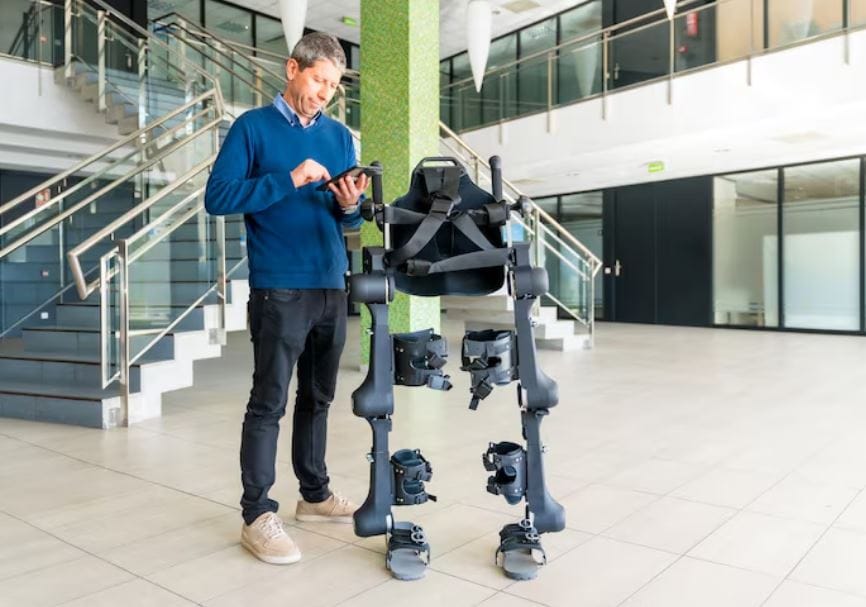
The research is understandable and a little startling. Exoskeletons can increase a soldier’s effective mission duration by up to 60% and reduce physical strain by up to 40%. These figures are derived from field simulations and clinical studies, including work published in peer-reviewed robotics journals that track exoskeleton performance in actual military drill environments. They are not taken from a corporate brochure. Systems in the lower limbs increase endurance. Strength is increased by upper-limb variations. More recent hybrid models aim to accomplish both.
The experience of Ukraine has given the discussion an unexpected sense of urgency. According to reports, lightweight aluminum-alloy exoskeletons weighing only two kilograms have been used to reduce leg muscle load by thirty percent. This is a significant figure in a conflict where soldiers must hold positions for days at a time under conditions that would exhaust anyone. It turns out that the battlefield serves as an accelerated testing environment. What is effective in combat is usually effective everywhere.
Of course, there are complications. The more powerful active systems, known as powered exoskeletons, rely on batteries for power and logistics in difficult-to-reach or disputed areas. The soldier inside a motorized suit faces a completely different kind of issue if it is damaged on the battlefield. Large forces continue to be extremely expensive to outfit. Furthermore, complex mechanical systems require specialized maintenance, which isn’t always compatible with field conditions.
Nevertheless, it’s difficult to ignore how rapidly this technology is progressing from conception to implementation. Passive exoskeletons have been used by China for patrol and supply missions along its border regions. Exoskeleton integration is a component of a larger combat system upgrade in Russia’s Sotnik program. Powered suits that can significantly increase human strength have been investigated by DARPA. The investment is expanding and quickening.
The underlying presumption about what a soldier should be expected to carry and endure is changing, not just the hardware. The physical limitations of infantry were long regarded as fixed variables that training could push but would never significantly change. Exoskeletons imply that those boundaries may be more negotiable than previously thought. It’s worth considering whether that’s a relief or a warning about what wars will ultimately demand of those who fight them.
